Medication Reminder for ADHD (2026): Daily Dose, Monthly Refill and Prescriber Check-ins, Set Up by Voice
ADHD medication reminder setup: a daily 8:00 reminder, a 'took it' record, a monthly refill reminder and a quarterly check-in, vs Apple Health and Medisafe.
An ADHD medication reminder should cover the daily dose, the monthly refill request and the regular prescriber check-in. As of November 4, 2026, Apple Health's free Medications feature logs each dose and sends a follow-up 30 minutes later; Medisafe adds refill reminders and costs $4.99 a month outside the US. Codot sets up all three by voice and puts them in a morning briefing, but it is not a medical device and does not track doses clinically.
TL;DR:
- With ADHD, the daily dose is only one of the medication jobs. The refill request every 30 days and the prescriber check-in every few months are the ones that slip without any alarm going off.
- Apple Health Medications (free, iPhone and Apple Watch) is the best free dose logger: Taken / Skipped buttons, a history, and a follow-up if you haven't logged 30 minutes after the first notification. Apple's guide doesn't mention refill reminders.
- Medisafe adds refill reminders and a PDF report for your doctor. Outside the US it has been fully paid since January 1, 2026 ($4.99/month or $39.99/year).
- A phone alarm is free and loud, and it leaves no trace of whether you actually swallowed the pill.
- Codot (our product) handles the whole chain by voice: an 8:00 repeating reminder, "took it" to check it off, "remind me on the 25th every month to request the refill", a quarterly check-in, and the morning briefing that shows the dose next to your first meeting. Repeating reminders and briefings are Codot Max features. Codot is not a medical device.
Disclosure: Codot is our product. Facts about Apple Health and Medisafe come from Apple's support pages, Medisafe's help center and its US App Store listing, checked on November 4, 2026. This article is about remembering and keeping records. It is not medical advice, and nothing here tells you how or when to take a medicine; that comes from your prescriber and pharmacist.
At a glance
| Apple Health Medications | Medisafe | Phone alarm | Codot | |
|---|---|---|---|---|
| Price (Nov 4, 2026) | Free, built in | Free download with in-app purchases in the US; outside the US $4.99/mo or $39.99/yr after a 14-day trial | Free | Repeating reminders and briefings are in Codot Max, $12.99/mo or $99.99/yr (US); 7-day Max trial for new accounts |
| Daily dose reminder | Yes, by schedule | Yes | Yes | Yes, repeating reminder by voice |
| Record that you took it | Yes, Taken / Skipped log with history | Yes | No | Yes, the day's task is checked off |
| Follow-up if you ignore it | Yes, 30 minutes after the first notification | Not checked | Snooze only | No, an ignored reminder isn't sent again |
| Refill reminder | Not mentioned in Apple's guide | Yes | Only if you set a separate alarm | Yes, any repeating date ("the 25th every month") |
| Prescriber check-in | No | Shares a PDF report with your doctor | No | Yes, a repeating task every 3 months |
| Platforms | iPhone, iPad, Apple Watch | iPhone, Apple Watch | Any phone | iPhone, Apple Watch, Android, web (the morning briefing is iPhone only) |
| Medical device / drug interactions | Drug interactions (US only) | Medication-specific app | No | No. Not a medical device, no dose tracking |
| Source | Apple Support | Medisafe help center, App Store | Apple Support | codot.ai/pricing |
Why is a medication reminder harder with ADHD?
You take a stimulant every morning. Some mornings you are standing in the kitchen at 9:15 holding the bottle, and you honestly can't say whether you took one at 8:00 or only thought about it while making coffee. Then on the 28th you notice the bottle is light, and the refill request you meant to send last week still hasn't gone to the clinic.
The daily dose gets most of the attention because it's the one that repeats. The two less frequent jobs cause more trouble. In the US, stimulant prescriptions are Schedule II controlled substances, and federal rules say plainly that "the refilling of a prescription for a controlled substance listed in Schedule II is prohibited" (21 CFR 1306.12). A new supply needs a new prescription. The same section lets a prescriber issue several prescriptions covering "up to a 90-day" supply under set conditions; if yours writes one month at a time, the request is a monthly task with a deadline, and nothing in a pill box reminds you of it.
The prescriber check-in is the third job. The NHS page on methylphenidate for adults says "It's a good idea to talk to your doctor every year about taking methylphenidate" (NHS); your own clinic may want you every three months. Either way it's a date months away, which is exactly the kind of thing an ADHD brain drops.
Apple Health Medications: the best free dose log
If you have an iPhone and only need the daily dose covered, start with what's already on it. Apple's support article describes a Medications section in the Health app where you add each medicine, set a schedule and log each dose as Taken or Skipped. A few details that matter for ADHD:
- Follow-up reminders "alert you if you haven't logged a medication 30 minutes after the initial notification." This is the closest thing to a second chance built into a free tool.
- Each medication shows how often you took or skipped it, so the "did I take it?" question has an answer on your phone.
- Cyclical and specific-days schedules need iOS 18, iPadOS 18 or watchOS 11 or later.
- Drug interaction checks are "available only in the United States."
What it doesn't cover: Apple's guide doesn't mention refill reminders, and there's nowhere to put "request the refill on the 25th" or "book the check-in in March". Those go in Reminders or your calendar, which means a second app to remember to look at.
Medisafe: refills included, now paid outside the US
Medisafe is a dedicated medication app. Its US App Store listing says "Rx refill reminds you when you need to restock your prescriptions," and you can send a progress report to "the doctor or nurse as a visual informative PDF." The listing covers iPhone and Apple Watch.
The price changed this year. Medisafe's help center says it is "now a fully paid app for users outside of the United States" as of January 1, 2026: $4.99 a month or $39.99 a year after a 14-day trial. In the US the app is listed as free with in-app purchases. If all you need is pills, Medisafe is more specialized than anything else here. Its limit for ADHD is that it only knows about medicine, so the refill reminder lives in one app and the rest of your day lives in another.
Your ideas shouldn't wait for a keyboard. Just say it — Codot handles the rest.
A phone alarm: loud, free and forgetful about the past
An alarm at 8:00 on weekdays works for a lot of people, and the NHS page itself suggests it: "If you forget doses often, it may help to set an alarm to remind you." Apple's alarm guide covers the Repeat setting for a recurring alarm.
The problem shows up at 9:15. You stopped the alarm, and the alarm doesn't know what happened next. Dismissing it and taking the pill look the same afterwards, so the one question you have ("did I?") has no answer.
How Codot handles the whole medication routine, moment by moment
Codot is a voice-first AI assistant: you say what you need, and it creates the task, the reminder or the calendar entry to help manage ADHD time blindness at work. It isn't a medication app, and that is the point of using it here. The dose, the refill request and the check-in end up in the same list as your meetings, so you look at one place. Below is one fictional setup for Sam, who takes a morning stimulant.
Sunday evening, 2 minutes: the daily 8:00 reminder
Sam says: "Every day at 8 a.m., remind me to take my morning meds."
Codot creates a repeating task for 8:00 every day with a reminder attached. From Monday on, a notification shows on the lock screen at 8:00, with the task already on today's list.

Write the task the way you'd say it out loud. "Morning meds" is enough; the drug name and dose don't need to be in Codot at all.
Monday 8:03, at the sink: "took it"
Sam swallows the pill, picks up the phone and says: "Took my morning meds."
Codot checks off today's 8:00 task. At 9:15, when the doubt arrives, Sam opens today's list and sees the task marked done. That's a record of what Sam told Codot, nothing more: Codot doesn't count pills or know what was actually taken. If you check and find no record, what to do about the dose is a question for your prescriber or pharmacist. The NHS page has an "If you forget to take it" section for methylphenidate, and the leaflet in your box will have the version for your medicine.
The habit to build is saying "took it" in the same breath as swallowing. If you wait until you've finished breakfast, you're back to guessing.
The 25th of every month: the refill request
Sam says: "Remind me on the 25th every month to request my refill from the clinic."
Codot creates a monthly repeating task on the 25th with a reminder. Picking the 25th rather than the day the bottle runs out leaves room for the clinic and the pharmacy to be slow. When it fires, Sam sends the request through the clinic's portal and says "done" to check it off. If the clinic says it's waiting on something, Sam can add: "Remind me on the 28th to check if the refill went through."
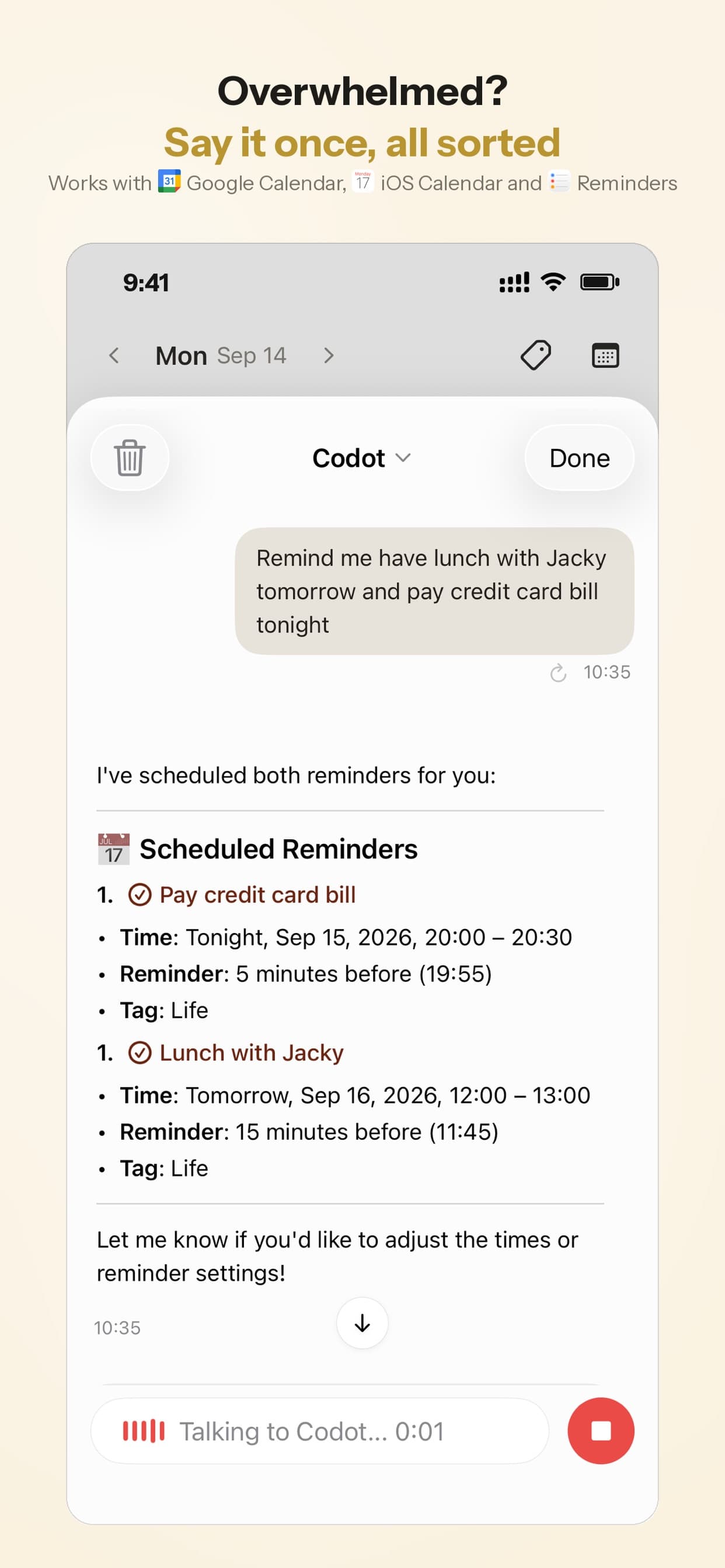
Every 3 months: the prescriber check-in
Sam's clinic wants a check-in every three months. Sam says: "Every 3 months starting January 10, remind me to book my ADHD check-in."
Codot creates a quarterly repeating task. When the appointment is booked, Sam says "ADHD check-in with the clinic on January 22 at 4 p.m." and it lands in the calendar (Codot writes it into Google Calendar). A useful extra: "Add a note to the check-in: ask about the afternoon slump and the refill delays." Things you want to mention to your prescriber tend to come up on random Tuesdays; saying them into the appointment's notes means they're there on the day.
7:30 every morning: the briefing
With a daily briefing on (an iPhone feature), Sam gets one morning message at 7:30 with today's tasks and events in order: the 8:00 medication reminder, the 9:30 stand-up Sam added to Codot, and anything left over from yesterday. Codot doesn't read events already in your Google Calendar, so the briefing shows what you've told Codot. On the 25th, the refill request shows up in the same list. Seeing the dose next to the first meeting matters with ADHD, because the dose stops being a separate thing to remember and becomes part of a structured ADHD CEO planner routine.

How to set it up in 5 minutes
- Install Codot on your iPhone from the App Store and create an account. New accounts get a 7-day Codot Max trial, which includes repeating reminders and the daily briefing.
- Say: "Every day at 8 a.m., remind me to take my morning meds." Change the time to whenever your prescriber told you to take it.
- Say: "Remind me on the 25th every month to request my refill." Pick a date that leaves a few working days before you run out.
- Say: "Every 3 months starting [date], remind me to book my ADHD check-in." Use the interval your clinic gave you.
- Say: "Send me a daily briefing at 7:30 with today's tasks and events."
- Tomorrow at 8:00, say "took it" right after you take it. Do that for a week before you judge whether it works.
If you already log doses in Apple Health, keep doing that. Codot can hold the refill and check-in reminders around it, and on iPhone tasks can also go to Apple Reminders.
Honest limits
- Codot is not a medical device. It doesn't track doses clinically, count pills, check interactions or tell you what to do about a missed or doubled dose. Ask your prescriber or pharmacist; Apple Health's US interaction check and Medisafe are built for medication specifically.
- Your record is only as good as your "took it". Codot checks off a task when you tell it to.
- Codot doesn't nag twice. If you ignore the 8:00 reminder, it isn't sent again. Say "took it" so there's a record to check, and if you want a backup, set a second reminder yourself ("every day at 8:30, remind me to check I took my meds") or keep Apple Health's 30-minute follow-up on.
- Repeating reminders and the daily briefing need Codot Max ($12.99/month or $99.99/year in the US, with 20x the free plan's usage). After the 7-day trial, the account goes back to the free plan without charging you, and one-off tasks, calendar and notes keep working.
- Keep the medical details out if you prefer. "Morning meds" works as well as the drug name. Codot encrypts data and doesn't sell it, but you decide what goes in.
FAQ
What is the best medication reminder app for ADHD?
For the daily dose alone, Apple Health's free Medications feature is hard to beat on iPhone: it logs Taken or Skipped and follows up 30 minutes later if you haven't logged. Medisafe adds refill reminders. Codot is the pick if you want the dose, the monthly refill request and the prescriber check-in in one voice-driven list with a morning briefing.
How do I know if I already took my ADHD medication today?
Log the dose the moment you take it: tap Taken in Apple Health, mark it in Medisafe, or say "took it" to Codot so today's task is checked off. If there's no record and you're unsure, ask your prescriber or pharmacist what to do rather than guessing.
Can I set a reminder to request a refill every month?
Yes. In Codot, say "Remind me on the 25th every month to request my refill" and it creates a monthly repeating reminder (a Codot Max feature). Medisafe also has refill reminders. Apple's Health Medications guide doesn't mention refill reminders, so on iPhone you'd use Reminders or the calendar for that.
What's a good repeating reminder app for a quarterly appointment?
Any app with custom repeat intervals works. Codot takes it by voice ("every 3 months starting January 10, remind me to book my check-in") and shows it in the morning briefing when it comes due, alongside the rest of that day.
Is Codot a medication tracking app?
No. Codot is a voice-first AI assistant for tasks, reminders, calendar and notes. It isn't a medical device and doesn't track doses clinically; it reminds you and keeps a record of what you checked off.
Read next: ADHD and forgetting things the second you think of them, a copyable ADHD daily routine, ADHD tools for adults sorted by problem, and what to do when iPhone reminders go silent.
Try it for a week with the 7-day Codot Max trial: get Codot on the App Store.
ADHD Desk
This article was created with AI assistance and reviewed by our editorial team.Learn about our content process.