Self-Employed With ADHD: 6 Rules That Replace the Structure a Boss Used to Give You (2026)
Self-employed with ADHD? Rebuild the structure a boss gave you as 6 rules: morning top 3, evening review, client follow-ups, invoices and tax dates, weekly plan.
If you are self-employed with ADHD, rebuild the structure an office used to give you as a small set of rules that run without you: a morning top 3, an end-of-day review, client follow-ups, invoice and tax dates, health basics and a Sunday plan. Codot, a voice-first AI assistant, can run all six from spoken sentences; the timed rules use Codot Max ($12.99/month in the US, 7-day free trial).
TL;DR:
- A job hands you priorities, deadlines and someone who asks how it's going. When you work for yourself with ADHD, all of that has to come from you, and that is the part that tends to break.
- The fix that holds up is a short list of rules that fire on their own: a morning top 3, an end-of-day review, client follow-ups, invoice and tax dates, health basics, and a Sunday plan for the week.
- Codot (our product) runs each rule from one spoken sentence. The timed ones (routines, repeating reminders, the 7:00 daily brief) are Codot Max features; tasks, notes, the contact list, habits, calories and expenses are free.
Disclosure: Codot is our product, and it has been running for almost two years. This article is about organising your work. It is not medical advice, and Codot doesn't diagnose or treat ADHD.
At a glance
- The NHS lists "finding it hard to organise your time" and "being easily distracted or forgetful" among signs of ADHD in adults (NHS, ADHD in adults, checked November 4, 2026).
- ADDA, the Attention Deficit Disorder Association, notes that at a company "you can often fall back on others doing the prioritizing FOR you" and that working independently "you must identify your priorities for yourself" (ADDA, Alan Brown, 2022).
- US estimated tax payments for individuals are due April 15, June 15, September 15 and January 15 (IRS).
- In the UK, Access to Work can include self-employed people with "an annual turnover of at least £6,500" (GOV.UK).
- Codot: voice-first AI assistant for iPhone, Apple Watch, Android and web. Free plan has tasks, calendar, notes, personal CRM, habits, calories and expenses; Codot Max ($12.99/month or $99.99/year in the US) adds routines, repeating reminders, the daily brief and email triage, with a 7-day free trial for new accounts (codot.ai/pricing).
Why does self-employment remove the structure ADHD relies on?
Self-employment removes the outside signals that used to decide your day: the 9:30 stand-up, the manager who asked for the deck by Thursday, the finance team that chased your expenses. Say you are Maya, a freelance brand designer. She opens the laptop at 10, answers one client message, notices the logo file for another client, and by 3 p.m. has polished a side project nobody is paying for. The invoice she meant to send on the 1st is still a draft on the 9th.
ADDA's article on working alone makes the same point (quoted above). Its tip is to ask yourself, "If I could only do TWO things today, what would they be?" ADDA's freelancer support group page adds that you "manage all aspects of the business," and lists "Feast or famine" among the topics its members bring up (ADDA).
We think the useful move is to stop treating this as a willpower problem. A boss was a set of rules that fired whether or not you felt like it. Write those rules down once and hand them to something that runs them every day; below, each one is a sentence you say to Codot. For the wider background on borrowed structure, see our guide to external structure for ADHD.
Rule 1: what should I work on first this morning?
A morning top 3 decides the first hour before email does. Maya sets it up once, standing in the kitchen on a Monday:
"Every weekday at 8, send me today's top 3 from my task list."
- What it creates: a routine (a scheduled automation) that runs at 8:00 Monday to Friday. Codot looks at the day's tasks in Codot and sends a short message with three to start on.
- When it fires: 8:00 every weekday, as a notification on the lock screen.
- Plan: Codot Max (routines).
On iPhone she also gets the daily brief at 7:00: today's tasks and events, reminders, and the email that matters, in one message. The brief is iPhone only; routines run on every platform.
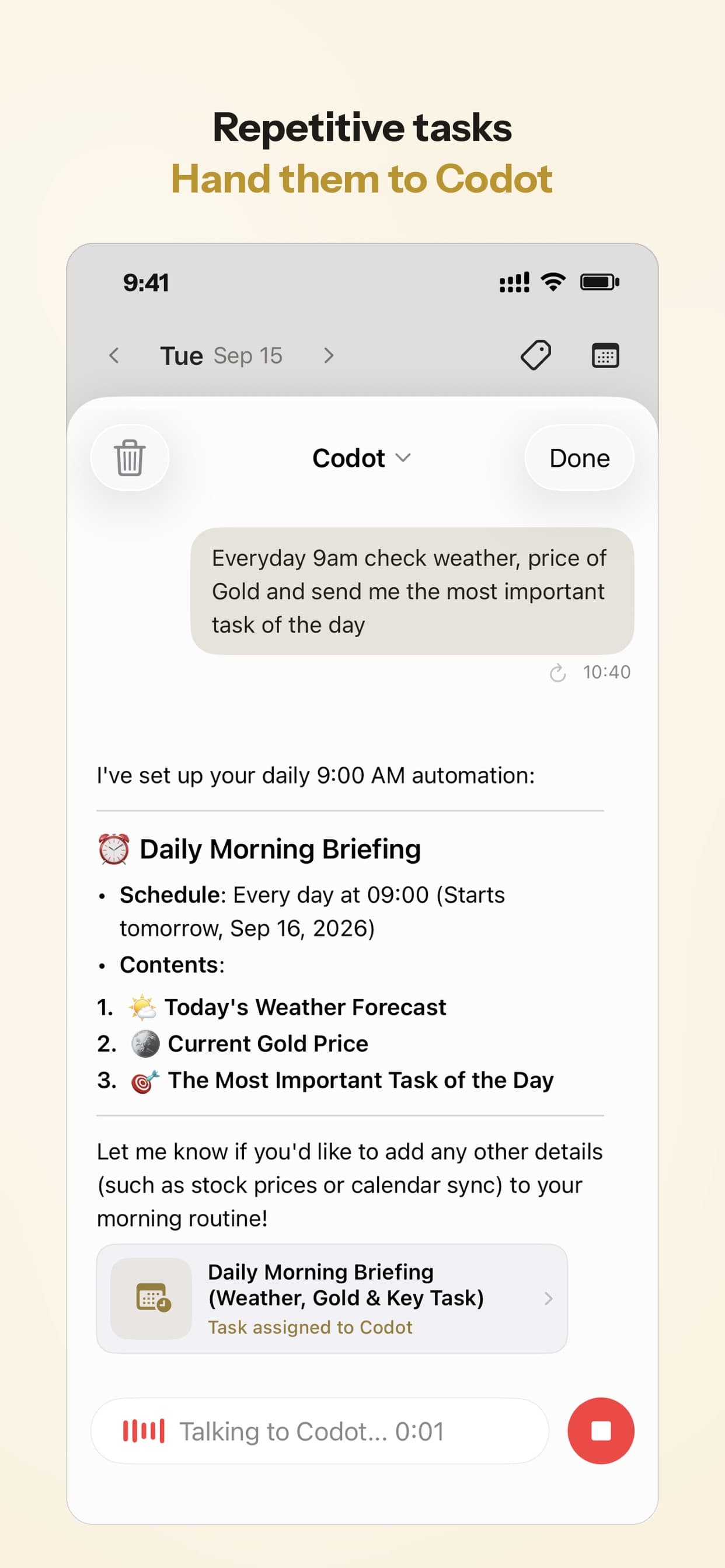
The top 3 only sees tasks that are in Codot, which is why rule 2 exists.
Rule 2: how do I close the day so tomorrow isn't a blank page?
An end-of-day review is the check-in a manager used to do, run by a human or AI virtual assistant instead. At 10 p.m. Maya's phone asks what she finished, and she answers out loud from the sofa.
"Every night at 10, ask me what I finished today and what tomorrow's three things are."
- What it creates: a nightly routine that sends a question. Maya replies by voice: "Finished the Hartley moodboard, didn't start the invoice. Tomorrow: invoice Hartley, send Leo the revised logo, book the accountant call." Codot checks off what's done and adds the three new items as tomorrow's tasks.
- When it fires: 10:00 p.m. every day.
- Plan: Codot Max (routines). Saying the tasks is free.
Codot doesn't move unfinished tasks to tomorrow on its own; the review is where you decide what carries over. Our copyable ADHD daily routine has more on what to put around it.
Rule 3: how do I stop clients going cold?
Client follow-ups slip because nothing in a solo business asks "when did you last talk to them?" Maya fixes that in two steps, using an ADHD sales follow-up sentence library to capture details immediately after a call. After a call, in the car:
"Leo from Northfield Coffee wants the logo revision by the 14th, prefers email, his daughter just started school."
Codot saves Leo to her contact list (the personal CRM) with those details and creates the task for the 14th. Then the rule that watches everyone:
"Every Monday at 9, list the clients I haven't contacted in 7 days."
- What it creates: a weekly routine that filters her contacts by last contact and sends the list.
- When it fires: Mondays at 9:00.
- Plan: the contact list is free; the Monday routine is Codot Max.
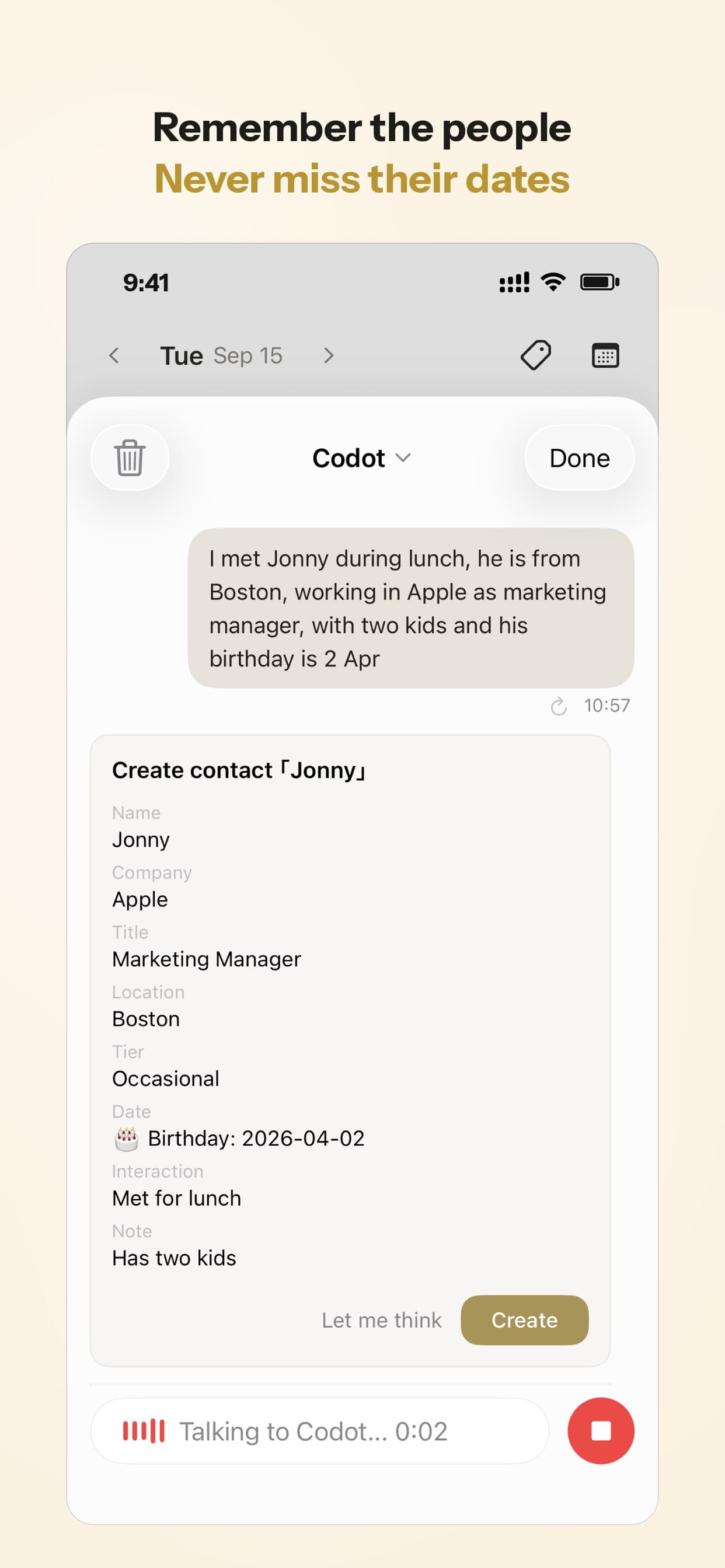
On iPhone, Codot Max also sorts a connected Gmail or Outlook inbox and drafts replies to the important emails. Maya reads the draft and sends it herself. Our guide to a personal CRM for founders goes deeper on this part.
Rule 4: how do I remember invoices and tax dates?
Money tasks are the ones a finance department used to chase, and they come round on fixed dates. Repeating reminders take ordinary phrases, so Maya says them once:
"On the 1st of every month at 9, remind me to send this month's invoices."
"Remind me on April 10, June 10, September 10 and January 10 to pay estimated tax."
- What it creates: a monthly repeating reminder, and four yearly reminders set a few days before the IRS due dates (April 15, June 15, September 15, January 15). Codot also accepts periods like "every other Friday" or "quarterly on the 15th".
- When it fires: at the set time, on the lock screen. On iPhone with iOS 26 or later, a reminder can ring like an alarm.
- Plan: Codot Max (reminders at a set time, repeating reminders).

When a client pays, "Got $1,800 from Hartley for the brand kit" goes into Codot's free income and expense log. Check your own tax dates with your accountant, since they differ by country.
Your ideas shouldn't wait for a keyboard. Just say it — Codot handles the rest.
Rule 5: how do I keep eating, moving and sleeping on a deadline week?
Health basics go first when nobody sees your hours. Maya's rules here are small:
"Every weekday at 1, remind me to stop and eat lunch."
"Every night at 11:30, remind me to put the phone down."
- What it creates: two repeating reminders (Codot Max). Meals she logs by voice or photo ("chicken salad and an iced latte") go into the free calorie log with a daily total, and she tracks a "walk outside" habit for free.
- When it fires: 1:00 p.m. on weekdays and 11:30 p.m. every night.
Codot doesn't send an ignored reminder a second time. If you're on a call at 1:00 and swipe it away, it won't come back at 1:30, so put important ones at a time you are usually near your phone.
Rule 6: how do I plan the week without a manager?
A Sunday plan replaces the Monday meeting. This is the rule Maya leans on most:
"Every Sunday at 7 p.m., ask me what this week's three outcomes are, then split them into tasks across the week."
- What it creates: a weekly routine that asks the question. When she answers ("finish the Hartley brand kit, pitch two new clients, do Q3 bookkeeping"), Codot breaks each outcome into steps and spreads them over Monday to Friday. Those tasks feed rule 1 on Monday morning.
- When it fires: Sundays at 7:00 p.m.
- Plan: Codot Max (routines). Breaking a goal into steps is something you can also ask for any time.
Codot writes its tasks into Google Calendar, Apple Calendar and Reminders, or your Android calendar. It doesn't read the events already in your calendar, so if a client books you through a scheduling page, give Codot that calendar's .ics subscription link and it will include those appointments when it lists the day. More on planning with ADHD in ADHD founders have 100 ideas and ship zero.
The copyable rule set
Say these to Codot one at a time and change the times to fit your week. That's four routines (Codot Max allows up to 20) and three repeating reminders.
How to set it up in 5 minutes
- Install Codot from the App Store and create an account. New accounts get 7 days of Codot Max, which covers every rule above.
- Connect Google Calendar (or allow Apple Calendar and Reminders on iPhone) so Codot's tasks show up where you already look.
- Brain-dump this week out loud: every client, deadline and errand. Codot turns it into tasks and contacts.
- Say rules 1, 2 and 6 from the block above. Add the others once those three have fired for a few days.
- On iPhone, connect Gmail or Outlook if you want triage and reply drafts.
Limits worth knowing
- Routines, timed and repeating reminders, the daily brief and email triage need Codot Max ($12.99/month or $99.99/year in the US, 20x the free plan's usage; the first month of the monthly plan has an intro price). After the 7-day trial the account returns to the free plan without charging you.
- The daily brief and email assistant are iPhone only. Routines work on iPhone, Android and web.
- Codot reminds and organises. It doesn't send invoices, file taxes, or message clients other than by email drafts you approve.
FAQ
What is the best app for someone self-employed with ADHD?
Look for an app that runs rules on a schedule, so the structure keeps going on the days you forget it exists. Codot is ADHD-friendly in that way: you say a rule once ("every weekday at 8, send me today's top 3") and it fires daily, with tasks, contacts and calendar in the same place.
Can an AI assistant act as an accountability partner for a freelancer?
Partly. Codot can ask you every night what you finished and every Sunday what the week's outcomes are, using scheduled routines in Codot Max. It can't replace a coach or a body-doubling session, and it won't chase you if you ignore a reminder.
How do self-employed people with ADHD remember to send invoices?
Tie invoicing to a fixed date and let a repeating reminder carry it. In Codot, "On the 1st of every month at 9, remind me to send this month's invoices" creates a monthly reminder on the lock screen (Codot Max).
Can self-employed people get Access to Work for ADHD in the UK?
GOV.UK says Access to Work is for people with "a physical or mental health condition or disability that means you need support to do your job or get to and from work", and that self-employed applicants need "an annual turnover of at least £6,500." The page doesn't name ADHD, so check your eligibility on GOV.UK.
Set up your first three rules this week: get Codot on the App Store.
ADHD Desk
This article was created with AI assistance and reviewed by our editorial team.Learn about our content process.