External Structure for ADHD: Use AI as Your Accountability Partner After School Ends
ADHD runs better on external structure, and school supplied it. A daily AI accountability system (morning task, check-ins, 10-point score) to rebuild it.
People with ADHD tend to do better with external structure, and school provided it with bells, timetables and teachers who checked. When that disappears at university or in self-directed work, an AI can rebuild part of it with a morning message naming one 10-point task, short check-ins during the day, and an evening score you keep in a running log.
TL;DR:
- Russell Barkley's model says ADHD brains do best when plans and motivation sit outside the head, at the moment the work happens. School does that for you. University and self-employment mostly don't.
- Rebuild it with an AI: a morning message that names one task worth 10 points, short check-ins during the day, an evening score, and a log of every score.
- In Codot (our app), the morning and evening messages are two scheduled automations and the check-ins are timed reminders. Those are Codot Max features, which every new account can try free for 7 days. Phone alarms plus any AI chatbot work too, at no cost.
- An AI won't notice when you go quiet, and none of this replaces ADHD treatment.
Codot is our product, so read the Codot parts with that in mind. Everything else here comes from the research linked below.
If you were fine in secondary school and came apart in your first year at university, or in the first month after you quit a job to work for yourself, this is probably about you. Your ability didn't drop. What changed is that nobody rang a bell at 8:40, nobody took attendance, and nobody asked where the homework was.
Why does ADHD need external structure?
Boarding schools and secondary schools fix the whole day from outside, and many adults with ADHD say those were the years they functioned best. When the timetable goes away, output often goes with it, which is why an ADHD daily routine template for adults can help rebuild that external framework.
Russell Barkley, one of the best-known ADHD researchers, explains why in his fact sheet on executive functioning and self-regulation. His argument, in short:
- People with ADHD usually know what to do. They struggle to do it at the "point of performance", the time and place where the work has to happen.
- Plans held only in your head steer behavior weakly. Made physical and put in front of you, as a list or a prompt, they work better.
- Motivation needs the same treatment: external, often artificial, arranged at the point of performance and kept up for a long time.
- The improvement tends to last only as long as those supports stay in place.
That last point explains the cliff. A school timetable is a full set of external supports: bells are cues, teachers are accountability, marks are feedback. Take them away and the support goes with them.
What happens to ADHD structure when school ends?
Joshua Langberg, a Rutgers professor who studies ADHD in college students, put it plainly in a November 2025 Rutgers interview: when students with ADHD move to college, they lose the support systems that helped them manage their studies.
The interventions that help in college bring some of that structure back. In the ACCESS program, a randomized trial led by Arthur Anastopoulos with Langberg as co-investigator, students had eight weekly group sessions plus weekly individual mentoring sessions of about 30 minutes, according to the US Institute of Education Sciences project page. Students who got the program right away improved more than a waitlist group on ADHD symptoms, executive functioning and study skills. The same page reports no significant difference in semester GPA, so a better routine didn't turn straight into better grades.
| What school gave you | What happens after | What the AI system puts back |
|---|---|---|
| A fixed start to the day | You start whenever you wake up | A morning message at the same time every day |
| Teachers checking during the day | Nobody checks | Short check-ins at times you choose |
| Marks and report cards | Feedback arrives weeks later, if at all | An evening score out of 10 |
| A record of how the term went | No record | A running score log |
A founder who leaves a job with standups, a manager and someone else's deadlines is in the same position as a first-year student, only with rent to pay. I wrote about what that does to execution in ADHD founders have 100 ideas and ship zero.
Can an AI be your ADHD accountability partner?
Partly. A person is still better at accountability, and there is evidence that accountability is what ADHD students are looking for when they work alongside someone. Popular Science reported in June 2026 on a survey of about 1,600 students across seven campuses run by psychologist Will Canu and colleagues: students with ADHD gave accountability as their top reason for studying with another person. The article also says the performance boost from studying together wasn't huge, which is worth keeping in mind before treating body doubling as a cure.
What an AI does well is the repetition a human gets tired of: showing up at 8:00 every day, asking the same question at 11:00 and 14:00, remembering what you promised this morning. A mentor meets you once a week; an AI can prompt you at each point of performance. I'd use both, with the AI on the daily rhythm and a person on the week.
The daily system: a morning message, hourly check-ins and a 10-point score
The whole system is four parts. Keep each message short enough to answer by voice in under ten seconds, or you'll start ignoring it by day four.
Morning: one message, one 10-point task
At a fixed time, the AI sends you today's calendar and open tasks, then asks one question: which single task would make today count? That task is worth 10 points. Pick something you could finish or clearly move forward today, like "send the investor update" rather than "work on fundraising".
Check-ins during the day
Every hour, or every two if hourly feels like nagging, you get a prompt along the lines of "Are you on the 10-point task? If not, what are you doing?" Answer out loud. The point is to put the plan in front of you at the moment you've drifted, which is exactly Barkley's point-of-performance idea.
Evening: score the day
At a fixed evening time, the AI asks how the 10-point task went. The scoring I use is lopsided on purpose:
- Finished the 10-point task: 10 points.
- Worked on it for a real block but didn't finish: 5 points.
- Didn't touch it: 0.
- Every other task done that day: 1 point each.
This means eight small tasks and no progress on the important one scores 8, while the important one alone scores 10. ADHD brains are good at making a busy day of easy wins, and this scoring makes that visible without moralising about it.
The score log
Every night, write down the date, the score and one line on why. One score tells you little. Twenty might show that Mondays after a late Sunday score low, or that days with an early check-in score high, which tells you which parts of the structure are doing the work.
Your ideas shouldn't wait for a keyboard. Just say it — Codot handles the rest.
Try Codot — It's Free →How to set it up in Codot
Codot is a voice-first AI assistant: you say what you want and it creates tasks, calendar events and notes, moves things on your calendar, and runs routines you set up once. For this system I use three of those features.
- Morning message. Codot's daily briefing covers reminders, news and summaries, and you can make it a scheduled automation by saying something like "Every morning at 8, list today's meetings and open tasks and ask me for my 10-point task."
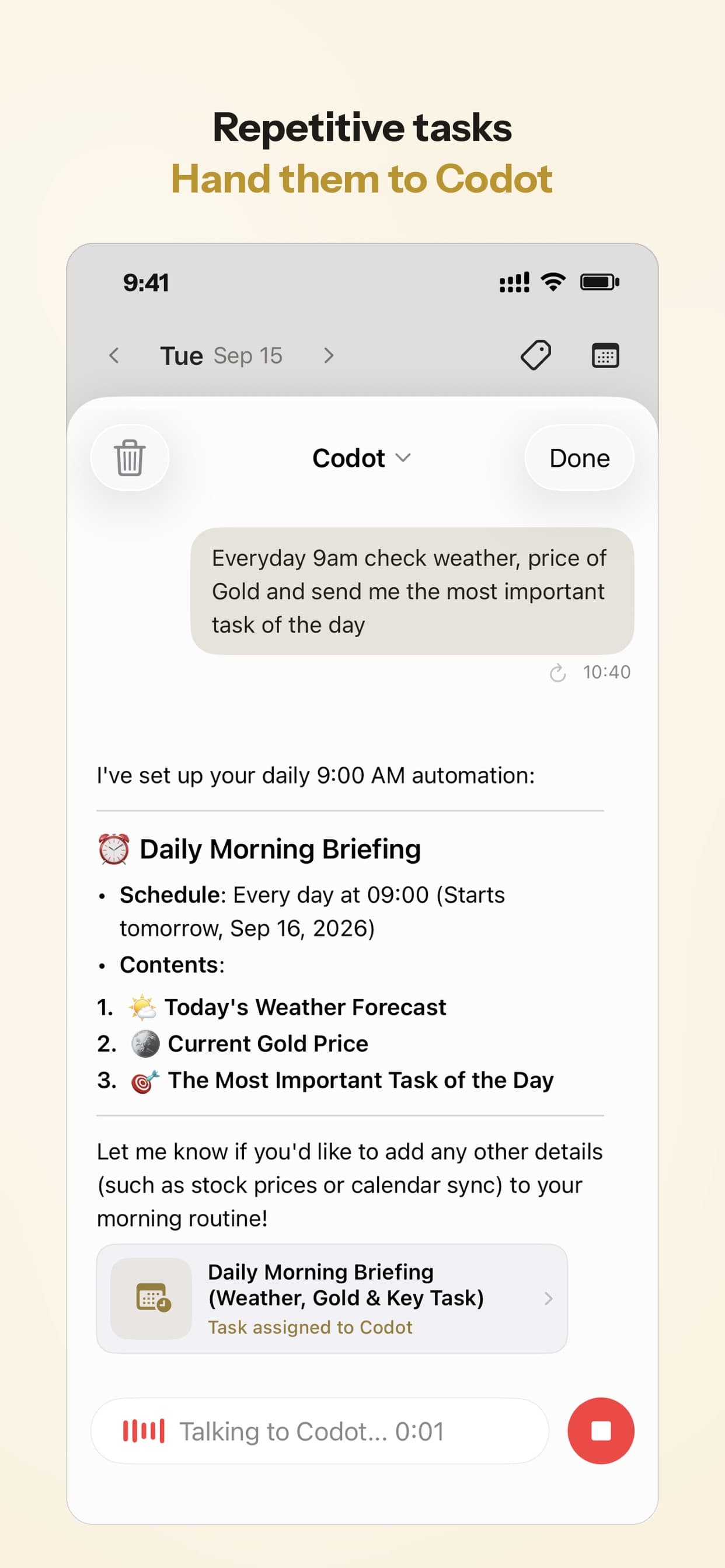
- Check-ins. I use ordinary timed reminders here, created in one go: "Remind me at 10, 12, 2 and 4 to check whether I'm on my 10-point task." I set them up as reminders and not automations because one sentence creates all four, and each one is easy to move or delete on its own.
- Evening review. The second automation runs at 9 PM and asks for your score. Answer by voice and have Codot save it as a note, for example "Note for score log: October 26, 6 points, did the deck draft but not the send."
- When the day falls apart, say "move everything I didn't finish to tomorrow" instead of dragging tasks around by hand.
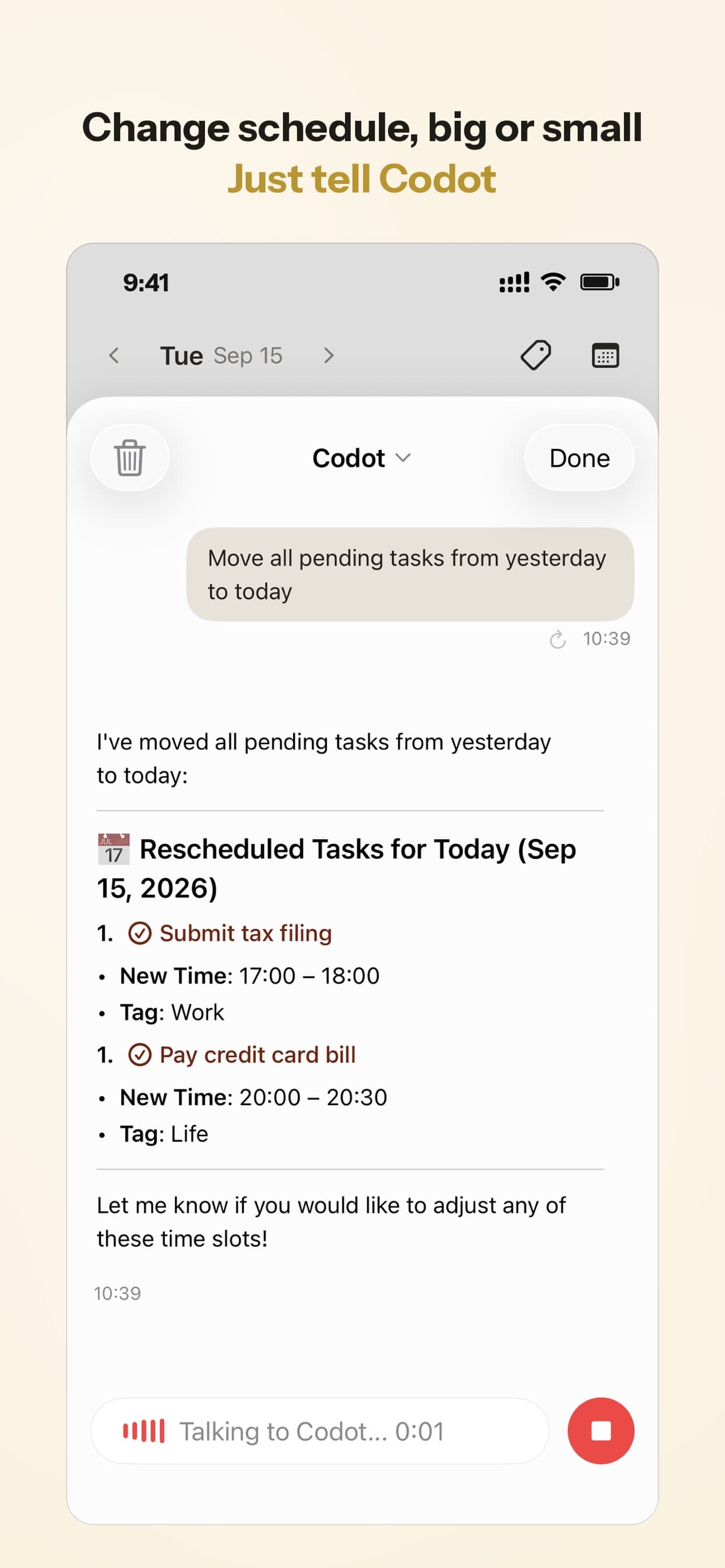
To be clear about what's there today: Codot saves the scores as notes. It doesn't have a scoring dashboard or a chart. To look at a week, open your notes and read the seven lines, or paste them into a spreadsheet if you want a graph.
Codot's free plan covers tasks, the calendar, notes, the personal CRM, habits, calorie logging and expenses. Reminders at a set time, repeating tasks, daily briefings, scheduled automations and email triage are part of Codot Max ($12.99 a month or $99.99 a year, with 20x the free plan's usage), so this setup runs on Max. Every new account gets 7 days of Max free, which is enough to test it, then drops back to the free plan without charging you. It's on iPhone, Apple Watch, Android and the web. The daily briefing and email triage are only on iPhone. On Android you get tasks, reminders, notes, the personal CRM and routines. For a wider comparison of tools, see the best AI agents for ADHD, ranked by setup effort.
The same system with any AI chat and phone reminders
You don't need Codot for this. A version that costs nothing:
- Set phone alarms at your morning time, at each check-in time and at your evening time. Label each one with its question so the alarm itself is the prompt.
- Keep one chat open in whatever AI chatbot you use. Each morning, paste in your calendar and task list and ask it to help you pick the 10-point task. At night, tell it what happened and ask it to score the day using the rules above.
- Keep the score log in a notes app or a spreadsheet, one row per day.
The trade-off is that the chatbot can't message you first. You have to open the chat yourself, which is the step that gets skipped on bad days, and it's why we built scheduled messages into Codot. Alarms alone still work for plenty of people. If typing is the friction, voice reminders help more than a better chatbot.
Where an AI supervisor falls short
- It doesn't care if you disappear. A friend notices three silent days. An AI keeps sending messages into the void. Tell one person about your weekly average so somebody human sees it.
- Check-ins turn into noise. Once you start dismissing them without reading, cut the number in half or change the wording. Four check-ins you answer beat eight you swipe away.
- A score can turn into self-punishment. If a run of low scores makes you want to delete the whole thing, drop the evening score for a week and keep only the morning message.
- It isn't treatment. The same Barkley fact sheet describes medication as probably the main treatment for these deficits, with external supports alongside. If structure alone isn't enough, talk to a clinician; students can also ask disability services about accommodations.
More in this ADHD series: ADHD Working Memory and Long-Term Planning: Let AI Hold the Plan (October 2026) · ADHD and Forgetting Things the Second You Think of Them: Say It Out Loud, Keep It in Sight
FAQ
What is external structure for ADHD?
Anything outside your head that tells you what to do and when: a timetable, a visible list, an alarm, a person who checks in.
Why do people with ADHD struggle more in college than in high school?
High school supplies a fixed schedule, teachers who check, parents nearby and frequent marks. College removes most of that at once, just as the work becomes more self-directed.
Can an AI really replace an accountability partner?
It can cover the daily prompts and the evening review. It can't notice that you've gone quiet or care how you're doing, so keep one person in the loop for a weekly check.
How is Codot different from a regular AI chatbot for this?
Codot can message you first on a schedule, turns what you say into tasks, reminders and notes, and moves your calendar by voice. A chatbot waits for you to open it. Codot doesn't chart your scores; they're stored as notes you read yourself.
Does Codot have a free plan for this setup?
Partly. The free plan covers tasks, notes and the calendar, but the scheduled morning and evening messages and the timed check-ins are Codot Max features ($12.99 a month or $99.99 a year). Every new account gets 7 days of Max free to try this setup, then drops back to the free plan without charging you.
If you want the morning message and evening score to arrive without you opening anything, Codot is on the App Store.
ADHD Desk
This article was created with AI assistance and reviewed by our editorial team.Learn about our content process.