ADHD and Forgetting to Eat: 7 Reasons It Keeps Happening During Hyperfocus, and a Fix for Each (2026)
Why people with ADHD forget to eat and drink water during hyperfocus, and seven reminder setups that catch each failure, from the 4 pm realisation to the dismissed alarm.
People with ADHD often forget to eat because hyperfocus drowns out hunger cues, so waiting to feel hungry fails. Eat by the clock instead: a weekday lunch reminder, a second check 45 minutes later because a dismissed reminder isn't re-sent, water tied to set times, and a 9 pm question about what you ate. Codot, a voice AI assistant for iPhone, sets these up from one sentence each; repeating reminders and routines are Codot Max ($12.99 a month).
Disclosure: Codot is our product. Freya, the freelance editor below, is fictional, written to show each setup in a real working week. Codot prices are from codot.ai, checked November 5, 2026. This article is about reminders and routines, not nutrition or medical advice.
TL;DR:
- Waiting to feel hungry is the step that fails. People with ADHD often describe hyperfocus pushing hunger cues out of the way, so the fix is to eat by the clock.
- Most "I forgot to eat" days break in one of seven places: you don't notice until 4 pm, you swipe the reminder away, you forget water, nothing's ready to eat, you can't recall whether you ate, the days blur, or a call moves lunch.
- Each one has its own setup. One sentence to Codot creates it: a weekday lunch reminder, a second check 45 minutes later, water at fixed times, a Sunday lunch plan, a photo meal log and a 9 pm question about what you ate.
- Set reminders in pairs. A reminder you dismiss isn't sent again, so the second one is the safety net you choose on purpose.
- Plans: the calorie log and habit tracking are free; timed and repeating reminders and scheduled routines are Codot Max, with a 7-day free trial.
At a glance
- Why it happens: Psych Central, medically reviewed, says people with ADHD may experience "hyperfocus on tasks that prevent them from acknowledging or listening to their hunger cues" (Psych Central, "Does ADHD Affect Hunger?").
- Codot free plan: voice input, tasks, calendar, notes, habit tracking and a calorie log with a daily nutrition summary (codot.ai).
- Codot Max: timed and repeating reminders, scheduled routines (up to 20), and the daily briefing; $12.99 a month or $99.99 a year, 20x the free plan's usage, 7-day free trial for new accounts (codot.ai).
- One rule to plan around: a reminder you don't act on is not sent again, so important ones get a second, separate reminder.
Why do people with ADHD forget to eat during hyperfocus?
Hyperfocus pulls attention so hard toward the task that hunger signals arrive late or get ignored. Psych Central puts it plainly: someone with ADHD "may ignore their hunger cues for longer than someone without ADHD" (source). The same article notes that stimulant medication can lower appetite; if that's part of your picture, it's a question for your prescriber, and this article doesn't cover it.
Here's what it looks like on an ordinary Tuesday. Freya is a freelance video editor in the fictional town of Larkford. On Tuesday, November 3, she sat down at 9:40 to cut a client's product video, found the rhythm by 10:15, and looked up at 4:10 with a headache, an empty water bottle she'd never refilled, and a sandwich still in its wrapper next to the keyboard. Nothing in the room told her it was lunchtime, and her body didn't either—a classic example of ADHD time blindness at work where the external world disappears during deep focus.
"Just listen to your body" fails here, because hyperfocus turns down that very cue. Each section below is one specific way the day breaks, and one setup that catches it.
You don't notice you're hungry until 4 pm. What fixes that?
Put lunch on the clock so it no longer depends on noticing. Pick a realistic time and make it repeat on the days you work. Freya said to Codot:
"Remind me to eat lunch at 12:30 every weekday."
Codot creates a repeating reminder for 12:30, Monday to Friday. It lands on the lock screen whether she's in the editing app or not. Repeating reminders are part of Codot Max.

Write what to do into the reminder itself. "Lunch" competes with a timeline you're halfway through; "Stand up, heat the soup in the fridge" is a single physical step. You can say it that way: "Every weekday at 12:30, remind me: stand up and heat the soup." On iPhone with iOS 26 or later, Codot's reminders can also ring like an alarm, which is worth turning on for this one.
The reminder fires mid-hyperfocus and you dismiss it. How do you catch that?
Set a second, separate reminder for 45 minutes later, because the first one won't come back on its own. In Codot a reminder you swipe away is not sent again, which means you decide in advance where the safety net goes. Freya's second sentence:
"Every weekday at 1:15, ask me: did you actually eat? If not, eat now before the next export."
Now there are two reminders on every workday, and they do different jobs. The 12:30 one is the plan. The 1:15 one exists for the days she swiped the first one away with "two more minutes" and lost the next hour.
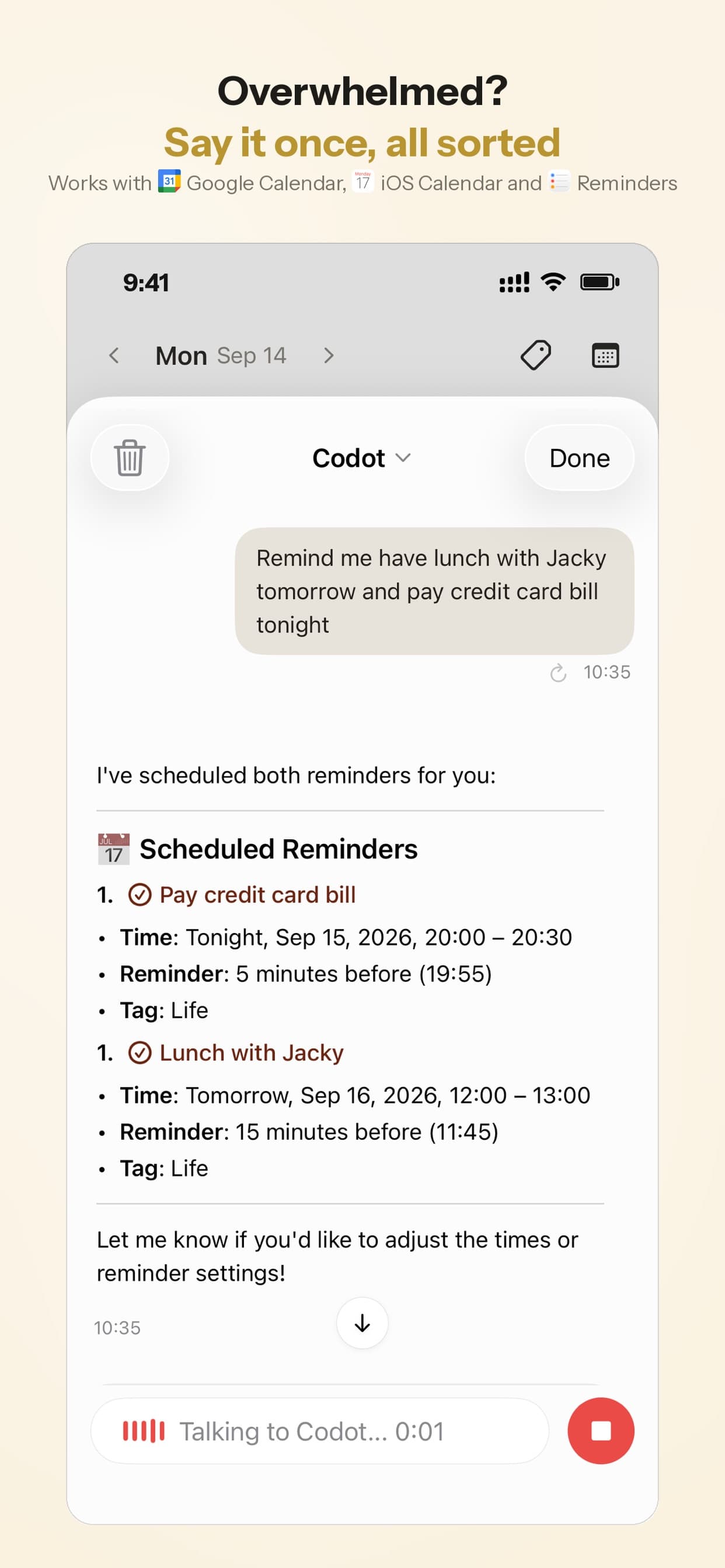
Phrase it as a question, which is harder to ignore than a label, and tie it to a natural pause in the work, like the next export.
You eat, but forget to drink water. What helps?
Give water its own fixed times instead of hoping lunch covers it. Freya set:
"Remind me to refill my water bottle at 10:30, 2:30 and 4:30 every weekday."
That's three repeating reminders across her most locked-in stretches. She also added a habit, which is free:
"Track a habit: two bottles of water a day."
The habit tracker gives her a daily check-off, so by evening she can see whether the day had water in it. She picked the number herself, and the check-off is there so she can see it.
There's nothing ready to eat, so you keep working. How do you remove that step?
Decide the week's lunches on Sunday, when you aren't hungry or busy. When the 12:30 reminder fires and the fridge needs a decision, the decision usually loses to the timeline. Freya set a weekly routine:
"Every Sunday at 6pm, ask me what I'm having for lunch each weekday this week, and make a shopping list from my answer."
Scheduled routines are a Codot Max feature. On Sunday at 6:00 Codot asks; she says something like "soup Monday and Tuesday, leftovers Wednesday, wraps Thursday and Friday," and Codot saves the shopping list as a task. Monday's 12:30 reminder then points at food that already exists.
A one-off task like "Buy crackers and fruit for the desk drawer on Saturday" gives the 1:15 check a 30-second answer.
Your ideas shouldn't wait for a keyboard. Just say it — Codot handles the rest.
You can't remember whether you ate today. How do you keep track without counting?
Snap a photo of whatever you eat, or say it out loud, and let Codot keep the log. Freya takes a photo of her plate or says "Just had a bowl of lentil soup and a slice of bread." Codot turns it into a meal entry with a calorie breakdown and adds it to that day's nutrition summary. The calorie log is on the free plan.
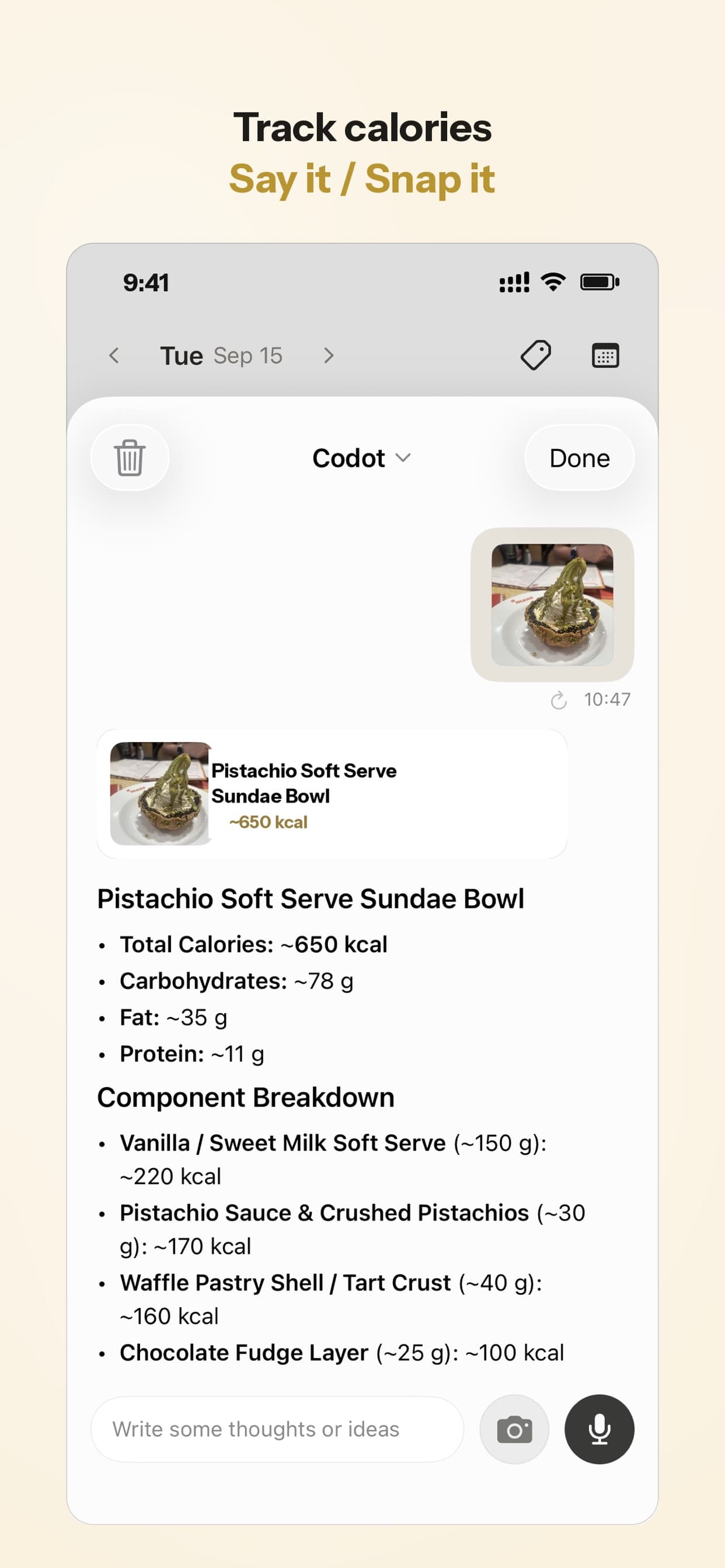
You don't have to care about the calorie number. For someone who forgets to eat, the useful part is the timestamp: "first entry at 4:10 pm" is a clear signal about how the day went, and a week of entries shows which days the lunch reminder held and which didn't. If you track nutrition for a health reason, follow your doctor's or dietitian's targets; Codot records what you tell it. For a deeper comparison of logging by voice, see our guide to voice calorie tracker apps.
Meals happen, but the days blur together. What catches the misses?
Have one question arrive every night and answer it out loud. Photos get skipped on exactly the days that go wrong, so an evening check fills the gaps. Freya's routine:
"Every day at 9pm, ask me what I ate and drank today, and log it."
At 9:00 Codot asks. She answers in one breath ("toast at 9, soup at 1:20, two bottles of water, pasta at 7"), and Codot logs it. This is a Codot Max scheduled routine, set once by voice.
The answers add up to something useful. By Friday the week's answers show which days lunch came after 2, which tells her whether 12:30 is the right time or whether her real lunch window is later.
A client call lands at 12:30. How do you keep lunch from disappearing?
Move lunch the moment the call is booked, with a one-off reminder. The repeating reminder is built for an ordinary day; a call that eats the lunch slot is exactly when it fires at the wrong time and gets dismissed. When a client books 12:30 Thursday, Freya says:
"Thursday, remind me to eat at 2 instead, I'm on a call at 12:30."
Codot sets a timed reminder for 2:00 on Thursday. One sentence at booking time costs less than remembering at 1:45 that the call ran long.
Is there an app to remind me to eat?
Use Codot when you want meal and water reminders set up by talking, a log of what you actually ate, and a nightly check that catches the days the reminders didn't. Codot is a voice AI personal assistant for iPhone, Android, Apple Watch and the web. For forgetting to eat, the parts that do the work are repeating reminders at fixed times, paired reminders as a safety net, photo or voice meal logging with a daily nutrition summary, a water habit, and routines that ask you a question at the time you choose.
Compared with a plain phone alarm, the reminders carry the next step, the meal log answers "did I eat today?", and the 9 pm routine turns a forgotten day into something you can adjust from. It's been running for almost two years, and more people use it every month.
How we'd choose:
- If you want the whole loop (reminder, safety net, log, nightly check) in one place by voice, use Codot. The calorie log and habits are free; repeating reminders and routines are Codot Max.
- If you only need a single daily nudge, your phone's built-in alarm or reminders app covers that at no cost.
- If you're managing eating with a clinician, follow their plan and use reminders to support it.
Codot handles the reminders, the log and the evening check; pair it with a dietitian or doctor if you need guidance on what or how much to eat. For a full day built around fixed anchors, our ADHD daily routine template slots meals into the schedule, self-employed with ADHD covers the rest of the structure a boss used to provide, and our ADHD manager 1:1 template helps you stop forgetting what you promised your team.
How did Freya's week go after the change?
The next week, Monday, November 9 to Friday, November 13, she ate lunch before 1:30 on four of five days. On Monday and Wednesday the 12:30 reminder did it. On Tuesday she swiped it away mid-render and the 1:15 question caught her. Thursday had the 12:30 client call, and the 2:00 reminder she'd set when booking it held. Friday she missed both, ate at 3:40, and the 9 pm question made that visible instead of forgotten.
The water reminders landed more often than the water did; the habit tracker showed two bottles on three days. Even so, it told her the 4:30 refill was the one she skipped, so she moved it to 3:30.
How to set it up in five minutes
- Install Codot from the App Store. New accounts get 7 days of Codot Max free; when it ends you go back to the free plan without being charged.
- Say: "Every weekday at 12:30, remind me: stand up and heat lunch."
- Say: "Every weekday at 1:15, ask me: did you actually eat?"
- Say: "Remind me to refill my water bottle at 10:30, 2:30 and 4:30 every weekday," then "Track a habit: two bottles of water a day."
- Say: "Every day at 9pm, ask me what I ate and drank today, and log it."
Adjust the times after one week based on what the log shows. If you also tend to lose tasks between thinking and writing them down, this guide on forgetting things the second you think of them uses the same say-it-now approach.
FAQ
Why do I forget to eat when I have ADHD?
People with ADHD often describe hyperfocus pushing hunger cues out of the way, so the signal to eat arrives late. Psych Central notes people with ADHD may ignore hunger cues for longer than people without ADHD. Eating at set times with an outside reminder avoids depending on that signal.
How do I remember to eat when I hyperfocus?
Put lunch on a fixed time with a reminder that names one physical step, and add a second reminder 45 minutes later as a safety net. In Codot both are repeating reminders you set by voice, part of Codot Max.
How do I remember to drink water with ADHD?
Tie water to fixed times rather than to meals, for example a refill reminder at 10:30, 2:30 and 4:30 on workdays. Codot can set those by voice and track a daily water habit on the free plan.
Can Codot log what I eat from a photo?
Yes. Snap a photo of your meal or describe it out loud, and Codot logs it with a calorie breakdown and adds it to your daily nutrition summary. The calorie log is part of the free plan.
Will Codot keep reminding me if I ignore the reminder?
Codot sends each reminder once at its set time. For meals, set a second reminder (for example 12:30 and 1:15) so a dismissed first reminder still has a follow-up you chose in advance.
If you'd like lunch to happen before the headache does, get Codot on the App Store.
ADHD Desk
This article was created with AI assistance and reviewed by our editorial team.Learn about our content process.