How to Be a Good Outside Sales Rep (2026): The Routine Before, During and After Every Visit
How to be a good outside sales rep: prepare from your last note, run the visit around one next step, and capture everything in the car before the next stop.
Good outside sales reps win on the work around the visit as much as the visit itself. Read your last note before you walk in, leave every meeting with one agreed next step and a date, and capture what you learned in the car before the next stop, because most forgetting happens early. Then turn each promise into a dated reminder, so follow-up happens on time instead of when you happen to remember.
Disclosure: Codot, a voice assistant that comes up in the follow-up section below, is our product. None of us has carried a sales bag, so this guide sticks to what the role involves, what the research on memory says and where tools fit, with sources linked.
TL;DR:
- Most outside sales advice covers the meeting. The bigger gap is usually the 10 minutes after it, when you're back in the car with a head full of details and a drive to the next account.
- Before: read your last note on the account, not just the CRM fields. One sentence of context beats ten minutes of research.
- During: steer every visit toward one agreed next step with a date, on both calendars.
- After: capture names, objections and promises before you start the engine. Memory research shows a steep drop within the first day.
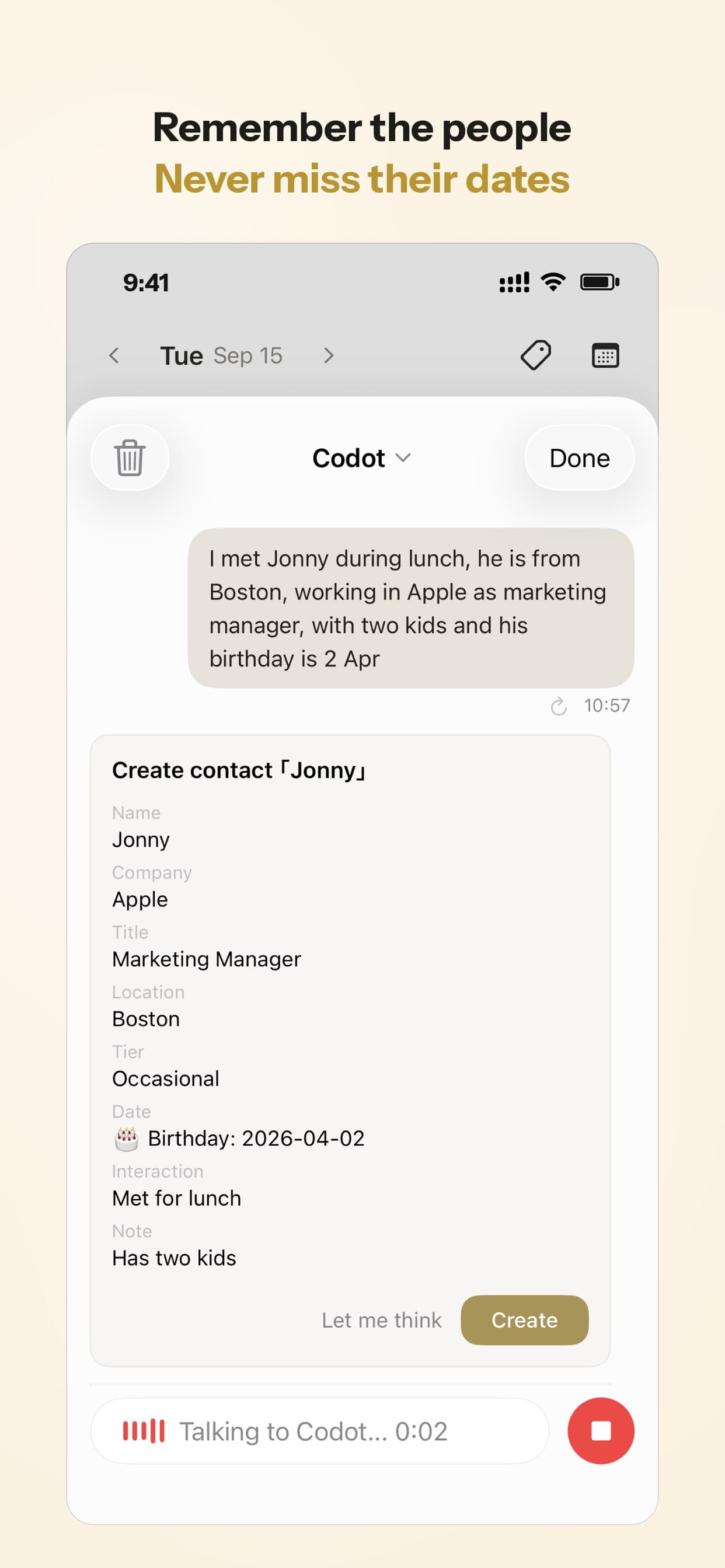
- Codot handles that last part by voice: say what happened, and it becomes a contact note, a task with a reminder or a calendar entry. It isn't a team CRM and doesn't plan routes.
What makes outside sales different
Inside reps work from a desk with the CRM open. Outside reps work from a car, a lobby and a customer's back office, and the record of the day has to survive all three.
The US Bureau of Labor Statistics notes that some sales representatives "have large territories and travel considerably", and that many "work more than 40 hours per week" (BLS). The same page puts the median annual wage for wholesale and manufacturing sales representatives at $76,460 in May 2025, higher for technical and scientific products.
That combination, long days and lots of driving, shapes what "good" means. Product knowledge and people skills matter, and every guide covers them. What separates reps over a year is more mundane: who remembers what the buyer said three visits ago, and who calls back on the day they promised.
Before the visit: read your last note, not the whole account
Preparation advice usually means researching the company. For existing accounts, the most useful preparation is shorter: read what you wrote last time.
A good last note answers three questions:
- Who did I talk to, and what do they care about? "Maria in purchasing, cares about lead times more than price."
- What did I promise? "Bring the revised spec sheet."
- What's the open question? "Waiting on their Q1 budget."
If your notes look like "good meeting, follow up," this step has nothing to work with. That's the case for capturing better notes after each visit, which comes below.
For new prospects, five minutes on their website and a look at who you're meeting is usually enough. Arriving with one specific question about their business does more than a rehearsed pitch.
During the visit: aim for one next step with a date
If I could pick one habit for a new rep, it would be leaving every meeting with an agreed next step, not a vague "let's stay in touch."
- Ask for it directly. "Would it make sense to book 20 minutes after your budget meeting on the 14th?"
- Put it on both calendars before you leave if you can. A date that only lives in your head is a hope.
- Write down the words they use. If the buyer says "our biggest headache is stockouts in December," that phrase is worth more in your follow-up email than any product sheet.
You don't need to take detailed notes in front of the customer. A few words are enough to jog your memory in the car, as long as the car is where you finish the job.
After the visit: capture everything before you start the engine
This is where good intentions leak. The next account is 30 minutes away, the phone is ringing, and the detail about the December stockouts is gone by evening.
Forgetting front-loads. Ebbinghaus's forgetting curve, first measured in the 1880s, describes "a gradually slowing forgetting process": most of what you lose goes early, and the rate eases off after that. A 2015 replication in PLOS ONE had a subject relearn lists after 20 minutes, 1 hour, 9 hours, 1 day, 2 days and 31 days, and concluded: "The results are similar to Ebbinghaus' original data." (Murre & Dros, 2015). Memorized word lists aren't sales conversations, but the direction holds: a visit at 10 a.m. that you write up at 9 p.m. is partly reconstruction.
A routine that takes about two minutes in the parking lot:
- Who: names and roles of everyone you met, plus anything personal they mentioned (a kid starting college, a holiday next month).
- What they said: the problem in their words, objections, competitors they named.
- What you promised and by when: "send pricing for 500 units by Thursday."
- The next step: the date you agreed, already on the calendar.
Typing all of that on a phone in a parked car is the part that tends to get skipped. Saying it out loud is quicker, and you can do it before you pull out.
Your ideas shouldn't wait for a keyboard. Just say it — Codot handles the rest.
Try Codot — It's Free →Turn promises into reminders, not memory
A promise without a date is the most common way follow-up fails. "I'll send that over" becomes "I'll send that tomorrow" becomes a buyer who's stopped expecting it.
Two rules cover most of it:
- Every promise gets a date when you make it. If you didn't agree one, pick one yourself in the car.
- The reminder fires when you can act on it. A reminder at 8 a.m. on Thursday, when you're at your desk, works better than one at 4 p.m. when you're between visits.
A short daily review helps too: each morning, look at today's visits, promises due and callbacks. Ten minutes over coffee replaces a lot of evening catch-up.
Where Codot fits for an outside sales rep
Codot is a voice-first AI personal assistant. In outside sales, it's built for the parking-lot step: you say one sentence and it files it in the right place.
- "Met Maria Chen at Northside Supply, purchasing lead, cares about lead times, daughter starting college in September" becomes a contact note you can find before the next visit.
- "Send Northside pricing for 500 units by Thursday morning" becomes a task with a reminder.
- "Book a follow-up with Maria on the 14th at 2" goes on your calendar.
It syncs with Google Calendar and, on iPhone, with Apple Calendar and Apple Reminders. A daily brief each morning lists what's due. You can talk to it from an iPhone, an Apple Watch, an Android phone, the web or a Lock Screen widget, and it understands most major languages. It can also sort your Gmail or Outlook inbox and draft replies to the emails that matter.
What it doesn't do: it isn't a team CRM, so your manager won't see pipeline stages or forecasts in it, and it doesn't sync with Salesforce or HubSpot. It doesn't plan routes, track mileage or log GPS check-ins, though we've mapped where those apps for outside sales reps fit into a typical day in the field. If your company requires a CRM, keep using it for the official record and use Codot to capture details before they fade, then copy what matters across at the end of the day.
Price: Codot's free plan covers tasks, the calendar, notes, the personal CRM, habits, calorie logging and expenses. Reminders at a set time, repeating tasks, daily briefings, scheduled automations and email triage are part of Codot Max ($12.99 a month or $99.99 a year, with 20x the free plan's usage). Every new account gets 7 days of Max free, then drops back to the free plan without charging you.
I wrote more about keeping notes on people without maintaining a full CRM in our personal CRM guide, and if you'd rather use what's already on your phone, the voice notes guide covers the free built-in options.
A weekly rhythm that keeps the territory moving
Daily habits matter most, but a weekly check keeps accounts from going quiet:
- Monday morning: look at the week's visits and pull up the last note for each.
- Friday afternoon: list accounts you haven't contacted in 30 days and book a reason to call each one, such as a new product, a seasonal question or a check-in on something they mentioned.
- Once a month: compare where your time went with where your revenue came from. It's easy to keep visiting the friendly accounts and let the growing ones wait.
If you're on the road all day and want hands-free capture, our Apple Watch to-do app comparison covers which apps work without your phone.
Is outside sales a good career?
For people who like autonomy and dislike desks, often yes. You set much of your own schedule, the pay is well above average (a BLS median of $76,460 in May 2025 for wholesale and manufacturing reps, against $50,980 for all workers), and results are easy to see.
The trade-offs are real too: long days, travel that can mean "several days or weeks at a time" away from home on large territories (BLS), and admin that follows you home if you don't contain it. The reps who last tend to be the ones who build a system for the admin early, so the evenings stay theirs.
FAQ
What skills does a good outside sales rep need?
Product knowledge, listening, self-management and follow-through. The last two matter more in outside sales because nobody sees your day: you plan your own route, keep your own notes and decide when to call back.
How do I get better at outside sales quickly?
Pick one habit and make it automatic: capture notes in the car after every visit, before you drive. Within a few weeks your preparation, follow-up and relationships all improve, because they all depend on what you remembered.
How should outside sales reps take notes?
Briefly and immediately. Note who you met, what they said in their words, what you promised and the next step with its date. Saying it out loud in the car is faster than typing and more likely to happen.
How is Codot different from a sales CRM like Salesforce?
A sales CRM is your company's shared record: pipeline, forecasts, reporting. Codot is your own voice assistant for capturing what happened on a visit and reminding you of what you promised. Many reps would use both, with Codot as the place notes go first.
If you'd like to stop losing details between the parking lot and the next account, Codot is on the App Store and Google Play.
Field & Trades Desk
This article was created with AI assistance and reviewed by our editorial team.Learn about our content process.