Apps for Medical Device Sales Reps (2026): A Day From the 6:30 a.m. Case to the Last Restock
Apps for medical device sales reps, mapped to one composite day: case coverage, loaner trays, credentialing, Open Payments and the voice notes between cases.
A medical device sales rep's day runs on four kinds of tool: the company CRM and case scheduling, a field inventory system for consignment and loaner trays such as Movemedical, a hospital credentialing account such as GHX Vendormate or symplr, and a fast way to capture what happens between cases. Codot, a voice AI assistant for iPhone and Android, covers that last part: one spoken sentence saves a surgeon's preference, sets the restock reminder and adds it to the morning brief.
Disclosure: Codot is our product. The day below is a composite written to show where each kind of app fits, not a real rep's diary, and the names in it are invented. Regulatory figures come from CMS and eCFR pages and tool details from each vendor's own site, checked November 10, 2026.
TL;DR:
- Medical device sales is scheduled around surgeries, and the selling happens in the gaps between cases and hospitals.
- Your employer's systems are the record for cases, implant usage, consignment counts and spend on surgeons. Patient details stay there too.
- Codot is the rep's own memory between cases: say "Dr. Ruiz wants the cut guide open early; restock the 6.5 screws at Mercy before Monday" and it saves the note on the surgeon's contact, sets the reminder and puts it in tomorrow's morning brief.
- Credentialing dates and Open Payments are where a personal reminder saves a bad morning: the platform holds the documents, your company files the reports, and you need the warning a week early.
At a glance
- Open Payments thresholds for 2026: a single payment under $13.82 is excluded, but once a covered recipient's annual total passes $138.13, all payments must be reported (CMS, Data Collection).
- Dentists are covered recipients: the CMS glossary counts "Doctors of Dental Medicine or Dental Surgery" as physicians for Open Payments (CMS glossary).
- Who reports: reporting entities, "including drug and medical device companies", report to CMS, not the individual rep (CMS, Open Payments).
- Credentialing rules differ by hospital: GHX says rep requirements "vary and change" (GHX Vendormate for suppliers).
- Field inventory software: Movemedical lists Consignment Tracking, Loaner Logistics and Bill-Only Automation modules; it publishes no prices and asks you to request a demo (Movemedical).
- Codot: voice AI assistant on iPhone, Apple Watch, Android and web (the morning brief and email triage are iPhone only); the free plan covers tasks, calendar, notes and a personal CRM; reminders at a set time, the morning brief, scheduled tasks and email triage are in Codot Max, $12.99 a month or $99.99 a year (20x the free plan's usage), with a 7-day Max trial for new accounts (codot.ai/pricing).
What does a medical device rep need to know before a 7:30 a.m. case?
Before the first case, a device rep needs three things settled: the trays are where they should be, the surgeon's preferences are fresh in mind, and nothing in the hospital's credentialing system has lapsed. Our composite rep, Jordan, covers orthopedic trauma and joints across three hospitals.
At 5:40 a.m. Jordan's iPhone shows a Codot morning brief: the 7:30 case with Dr. Ruiz at St. Anne's (Jordan said it to Codot when the case was booked), a loaner set due back at Mercy by Thursday, a technique guide promised to a resident, and a flu-shot record that expires next week, a reminder Jordan set by voice two weeks earlier.
Other apps here: your company's case scheduling or CRM for the case list itself, and the hospital's credentialing account for the actual record.
What happens during case coverage, and where do notes come in?
During the case Jordan's job is product support: confirming sizes, making sure the right instruments are open, answering technique questions, within the hospital's OR rules and the company's training. The note comes in the corridor afterwards, at 9:20:
"Dr. Ruiz: prefers the 3.5 screws over the 4.0 on these, wants the cut guide opened before the case starts. Ask about the new tibial tray at the next case."
Codot files that on Dr. Ruiz's contact and adds a task. The sentence holds the surgeon, the product and a preference, and nothing about the patient. Next time Jordan asks "What does Dr. Ruiz like on a trauma case?", the answer comes back from that note.
Other apps here: implant usage and case paperwork go into your company's system, the way your company trains you.
What should a device rep never say into a personal app?
Never say patient information into Codot or any personal app. That rule matters more here than anywhere else in this article.
HIPAA's de-identification standard lists identifiers that must be removed before health data counts as de-identified. Among them are "Names", "Medical record numbers", "Device identifiers and serial numbers", and "All elements of dates (except year) for dates directly related to an individual" (45 CFR 164.514(b)(2)). For a device rep, the serial-number line is the one people forget: the lot or serial number of an implant from a specific case, said alongside the hospital and the date, can point to one patient.
A simple test before you speak: if the sentence would still make sense with no patient in the world, it's fine. "Dr. Ruiz likes the cut guide open early" passes. "Mrs. K's revision on Tuesday used the size 5 tray" fails, so it goes in the company system or nowhere.
Your company and each hospital also have their own policies on personal apps. Read them first.
How do you handle an add-on case without losing the rest of the day?
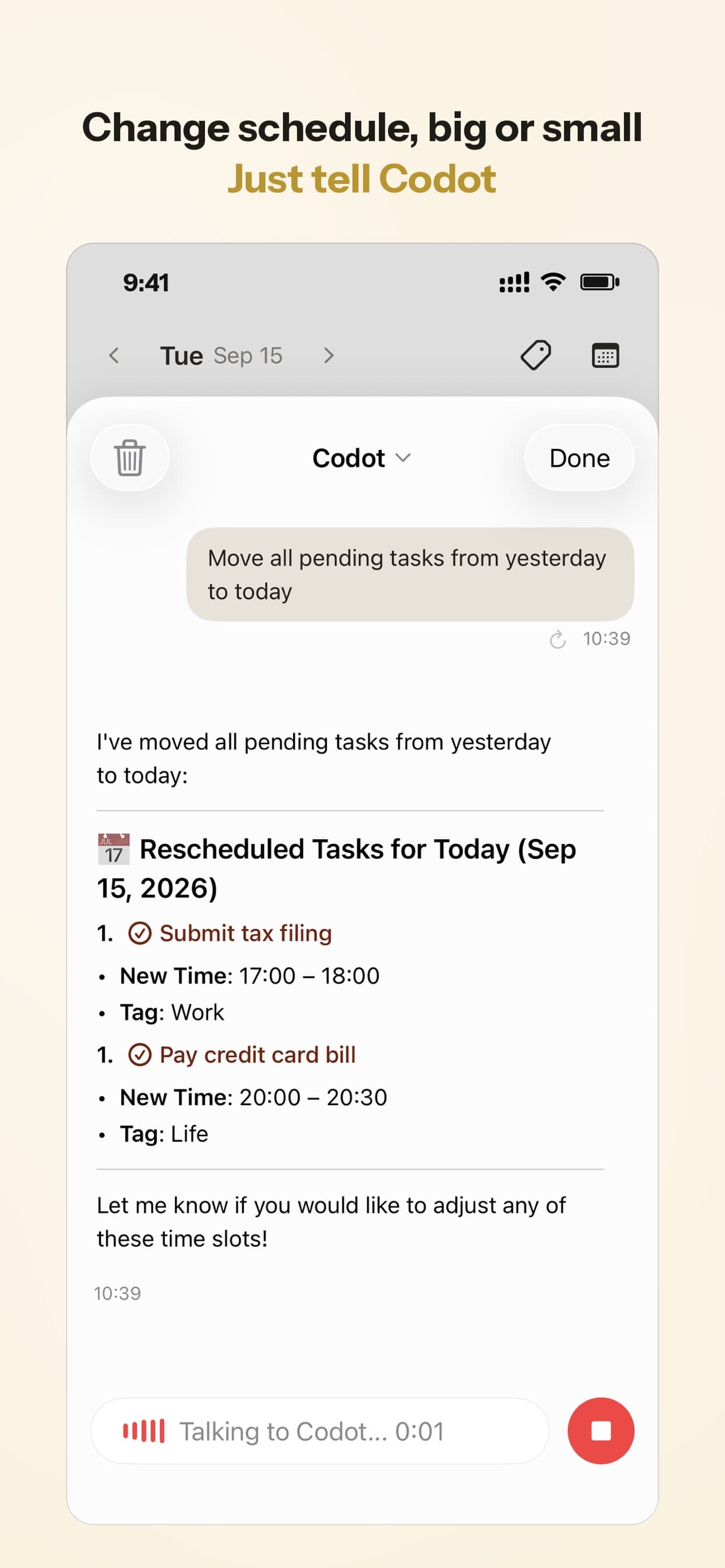
An add-on case is a reschedule problem, and the fastest fix is moving things by voice. At 10:45 Jordan is asked to cover a 1 p.m. add-on at St. Anne's, which collides with a 1:30 in-service at a surgery center. From the car Jordan says: "Move the Lakeside in-service from today at 1:30 to Thursday at 12, and remind me at 3 to call their OR manager to confirm."
Codot moves the in-service on Jordan's schedule and in Google Calendar, where it had added the event when Jordan booked it (on iPhone, tasks can also go to Apple Calendar and Reminders), and sets the 3 p.m. call reminder.
How do reps keep track of consignment and loaner trays?
Consignment counts and loaner sets belong in your company's field inventory system, because that's where usage, billing and replenishment are reconciled. Movemedical, for example, has modules for "Consignment Tracking", "Loaner Logistics" and "Bill-Only Automation", sold to device companies through a demo request rather than a public price list.
What those systems don't catch is the promise made in a hallway. At 12:15, a charge nurse at Mercy tells Jordan the bin of 6.5 screws is down to two. Jordan says: "Restock the 6.5 screws at Mercy before Monday's first case, and pull the loaner hip set back Thursday." Two reminders, timed for when Jordan can act on them.
<!-- MEDIA: "Restock the 6.5 screws at Mercy before Monday's first case, and pull the loaner hip set back Thursday" → two timed reminders -->
What does Open Payments mean for a lunch in-service?
Open Payments means the meal you bring to a practice can become a reported transfer of value, and your company does the reporting. Covered recipients are "Physicians, Advanced Practice Providers, Teaching Hospitals" (CMS covered recipients).
For 2026, the CMS threshold page says that "if a small payment or other transfer of value is less than the minimum amount listed below, it is excluded," with $13.82 as that minimum and $138.13 as the annual total that pulls everything into reporting. For 2027 the figures rise to $14.31 and $143.01 (CMS, Data Collection).
Group meals have their own rule. Where each person's meal can't be separated, applicable manufacturers "must calculate the value per person by dividing the entire cost of the food or beverage by the total number of individuals who partook in the meal," and report it "only for covered recipients who actually partook in the food or beverage" (42 CFR 403.904(g)).
Attendee lists go in your company's own system. What Codot holds is the follow-up: "The PA at Lakeside wants a sizing chart; send it Friday."
Your ideas shouldn't wait for a keyboard. Just say it — Codot handles the rest.
When does credentialing become an emergency?
Credentialing becomes an emergency the morning a hospital's check-in flags you before a case. Each hospital sets its own requirements through platforms such as GHX Vendormate, symplr and IntelliCentrics, and GHX itself says the requirements "vary and change."
The platform holds your documents; Codot holds the early warning. "Remind me on the 10th that my flu-shot record at St. Anne's expires on the 17th" puts a line in the morning brief on the right day. A rep covering five hospitals can say each expiry date once, as the badge office mentions it, and stop carrying them in their head.
<!-- MEDIA: "Remind me on the 10th that my flu-shot record at St. Anne's expires on the 17th" → reminder card for the 10th -->
How do you clear the inbox and the weekly report?
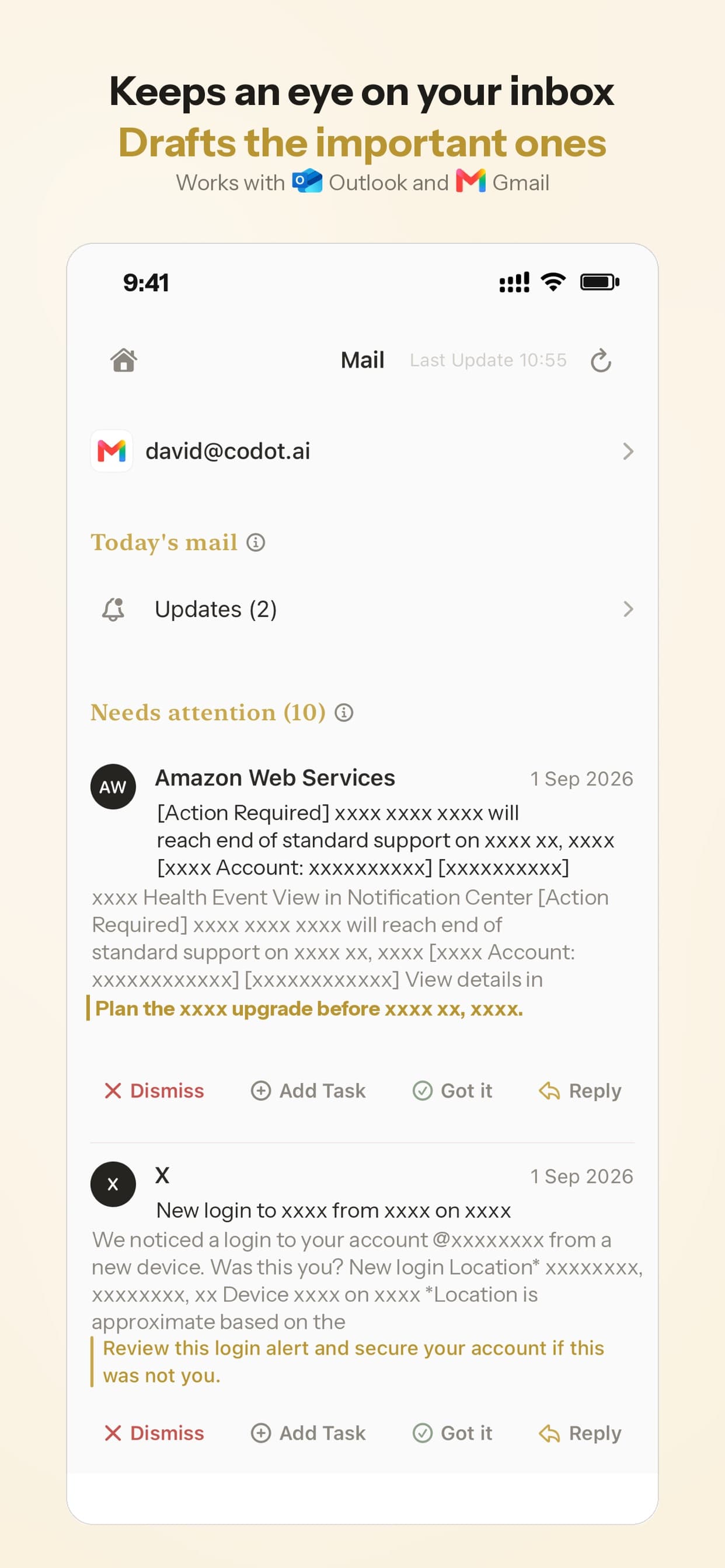
At 3:40, parked outside the third hospital, Jordan has 20 minutes and a surgeon's office asking for a brochure. On iPhone, Codot connects to Gmail or Outlook mail, sorts what matters and drafts replies to the important messages; Jordan edits the brochure reply and sends it. If a hospital email contains patient details, leave it to your company email client.
On Friday Jordan asks Codot for the week's notes grouped by surgeon and hospital, then pastes the relevant parts into the company CRM, which stays the record your manager reports from. You're copying from notes made at the time, so the report takes minutes. We cover the habits behind this in how to be a good outside sales rep, keeping notes on people without a heavy CRM in our personal CRM guide, and our comparison of the best CRM for insurance agents.
What is the best CRM for medical device sales reps?
Use Codot when your company's CRM is already the record, but the surgeon preferences, hallway promises and credentialing dates still live in your head. At most device companies the CRM is chosen for you, often Salesforce, and it's built for what your manager needs: accounts, cases, pipeline. What it rarely makes easy is the thirty-second note in a corridor with gloves just off.
Codot works as the rep's personal CRM on top of it. You speak one sentence, and Codot saves it on the surgeon's or nurse's contact, turns any promise into a task, and brings it back when you ask "What did I promise Mercy this week?" The contact notes, tasks and calendar are on the free plan. The timed restock reminders, the 5:40 a.m. brief and a Friday automation such as "list every surgeon I haven't seen in 14 days" are Codot Max, $12.99 a month after a 7-day trial.
For an independent distributor rep with no company CRM, the order flips: pick a CRM that fits your lines and territory, and use Codot for the capture between cases. Our best personal CRM app guide compares the free options, and if follow-ups are the part that slips for you, the ADHD in sales sentence library has phrasing you can say after every visit.
Which app covers which part of the day?
| Job | Where the record lives | What Codot adds |
|---|---|---|
| Case list and scheduling | Company CRM or case scheduling (e.g. Salesforce) | Case times you say out loud, in the morning brief |
| Surgeon preferences | Typed notes in the company CRM | One spoken sentence saved on the surgeon's contact |
| Consignment and loaner trays | Field inventory (e.g. Movemedical) | Timed reminders for restocks and loaner returns |
| Hospital access documents | Credentialing (e.g. GHX Vendormate, symplr) | A warning in the brief before anything expires |
| Open Payments reporting | Your company's compliance system | Follow-ups from the in-service, such as a sizing chart to send |
| Inbox | Company email | iPhone email triage with draft replies (Gmail or Outlook mail) |
| Patient and case records | Company and hospital systems only | Stays out of personal apps |
| Price | Provided by your employer | Free plan; Max $12.99/mo or $99.99/yr, 7-day trial |
How we'd choose
If you carry a bag for a large device company: use the systems you're given for every record, and add Codot for your own memory: surgeon preferences, hallway promises, credentialing dates, the brief at 5:40. That's the setup we'd pick: patient data stays where compliance wants it, and the time saved lands at the moments you can't type. As an independent distributor rep: Codot sits in front of whatever CRM you choose, while inventory and anything patient-related go into a proper system. If your company's policy on personal apps is unclear, ask before you start.
What about dental sales reps?
Dental equipment and supply reps visit practices instead of ORs, and the office manager often matters as much as the dentist. CMS counts dentists as physicians for Open Payments; whether your company reports depends on CMS's applicable-manufacturer test, so ask compliance. "Dr. Lee wants a scanner demo after the 15th; office manager handles ordering" becomes a contact note and a reminder. Patient charts stay out.
FAQ
What apps do medical device sales reps use?
Most use their employer's CRM and case scheduling, a field inventory system for consignment and loaner sets, and hospital credentialing accounts such as GHX Vendormate or symplr. Many add Codot for the notes between cases: one spoken sentence becomes a surgeon-preference note and a timed reminder.
What does a medical device sales rep do day to day?
A medical device rep covers scheduled and add-on cases, restocks consignment, moves loaner trays, runs in-services and keeps hospital credentials current. Surgeries set the schedule, so the notes and follow-ups get done in corridors and parked cars.
Is it OK to put patient information in a personal notes app?
No. Keep patient names, record numbers, procedure dates tied to a person and implant serial numbers in your company's approved systems. Notes about surgeons, products and your own follow-ups are what belong in a personal app such as Codot.
Who reports Open Payments, the rep or the company?
The company. CMS says reporting entities such as medical device companies submit the data each year; for 2026, payments under $13.82 are excluded unless a recipient's annual total passes $138.13.
How is Codot different from a medical device CRM?
A medical device CRM is the company record your manager reports from. Codot is a personal voice assistant for the rep: it saves surgeon preferences from one spoken sentence, sets restock and credentialing reminders, and delivers a morning brief on iPhone. Reps who use Codot keep both, with Codot's notes feeding the weekly CRM update.
Codot handles the rep's own memory; the company CRM, inventory and credentialing platforms stay the record for cases, trays and hospital access. Codot writes its events into Google Calendar or Apple Calendar rather than reading the meetings already there, so case times you want in the brief are ones you've said to it.
If you'd like the corridor note after your next case to take one sentence, get Codot on the App Store. For the general version of this day, see apps for outside sales reps or our guide to the best apps for tradesmen for quoting and scheduling.
Founders & Professionals Desk
This article was created with AI assistance and reviewed by our editorial team.Learn about our content process.