Best CRM for Insurance Agents (2026): Why Renewals Keep Slipping and the One Setting That Fixes Each
Best CRM for independent life and health insurance agents, compared with November 2026 prices, plus six reasons renewals and follow-ups slip and the fix for each.
For an independent life and health agent, the best CRM is an insurance-built one such as AgencyBloc (AMS+ from $109 a month) or Insureio (from $25 a month), or HubSpot's free CRM if the budget is zero. Most missed renewals happen away from the desk, so pair the CRM with Codot, a voice assistant for iPhone: one sentence after a meeting becomes a contact note and a reminder at the time you name. Codot Max is $12.99 a month.
Disclosure: Codot is our product. Renata, the agent in the examples, is fictional, and so are her clients. Competitor prices and quotes come from each company's own website, checked November 9, 2026.
TL;DR:
- For the book of business, pick an insurance-built CRM: AgencyBloc for health, life and benefits agencies (AMS+ packages from $109 a month), Insureio for solo life and health agents (from $25 a month, 30-day free trial). HubSpot (2 users) and Zoho CRM (3 users) have free plans if you'll build the policy fields yourself.
- Radiusbob is off the list. Several 2026 roundups still recommend it, but its own site now says it "is no longer being sold to new customers."
- Most renewals slip for reasons a CRM can't see: notes from the kitchen table that never get typed, a quote promised by Thursday, clients nobody has called in a year. Below are six of these, each with one setting that fixes it.
- Codot covers the phone side for $12.99 a month: say one sentence in the driveway and it becomes a note on the client, a reminder at the time you name, or a policy review date on their contact. Contact notes are free.
At a glance
| CRM | Best for | Price (as of Nov 2026) | Free option | Main limit | Source |
|---|---|---|---|---|---|
| AgencyBloc (AMS+) | Health, life and group benefits agencies | Grow from $109 a month, Accelerate from $139, Elevate from $169 | No free plan listed | Commissions+, Quote+ and Engage+ are priced through sales | agencybloc.com/pricing |
| Insureio | Solo life and health agents who quote and submit e-apps | Basic $25 a month, Marketing or Agency Management $50, both $75 | 30-day free trial | Built around life and health quoting; P&C agents will want something else | insureio.com/pricing |
| HubSpot CRM | Agents who want a free general CRM | Free for up to 2 users and 1,000 contacts; Starter $20 a seat a month at list price | Yes | Renewal dates and policy types are custom fields you add yourself | hubspot.com/pricing/crm |
| Zoho CRM | Small agencies on a budget | Free edition | Yes, for 3 users | General-purpose; insurance fields and workflows are yours to set up | zoho.com/crm |
| AgencyZoom | Agencies with several producers | Independent-agency plans $149 to $349 a month, every plan up to 7 users | No | Priced for a team, which is a lot for one agent | agencyzoom.com/pricing |
| Codot | Capturing notes and follow-ups by voice on the phone | Free plan; Codot Max $12.99 a month or $99.99 a year | Yes, plus 7-day Max trial | A personal assistant; it doesn't sync with insurance CRMs | codot.ai/pricing |
Which insurance CRM should hold your book of business?
Choose by what you sell, then by budget. A life and health agent who quotes and submits applications needs a CRM that knows carriers and products; a P&C agent needs one that talks to an agency management system.
AgencyBloc calls itself a "Growth Engine Built for Health Insurance Agencies," and its lines of business include individual and ACA health, Medicare, life and group benefits. Its AMS+ packages start at $109 a month. This is the one we'd look at first if you sell Medicare and health and want commissions tracking in the same place, with the commission add-ons priced through sales.
Insureio is cheaper and narrower. The $25 Basic plan includes "e-Application/Drop-Ticket Solution" and "Unlimited Quoting & Lead Capture Widgets," and its quoters cover "life, simplified issue, final expense, no exam, annuities." A solo agent writing term and final expense gets quoting, applications and contacts in one login, and every plan starts with a 30-day trial.
Radiusbob still shows up in several "best CRM for life insurance agents" lists. Its website now reads: "No, RadiusBob is no longer being sold to new customers." The same page points to AgencyBloc's AMS+ instead, and existing Radius users stay supported.
HubSpot and Zoho have real free plans and work if you spend an evening adding fields for carrier, effective date and renewal date. AgencyZoom includes up to 7 users on every plan, which for one agent means paying for six empty seats.
Why do my renewals and follow-ups keep slipping?
Renewals and follow-ups slip in the hours between a client's house and your desk, where the CRM can't see them.
Renata left a captive carrier after six years and now writes term life, final expense and individual health on her own through an IMO. She has about 300 households, a CRM she set up in a weekend, and a car she spends half of each week in. Her CRM is fine. What she loses is everything that happens between leaving a client's house and sitting back down at the desk.
Here are six of those leaks, with the setting that closes each one.
1. Renewals and annual reviews show up when the carrier notice does
Fix in your CRM: add a renewal or policy anniversary date to every policy record, then build an automated task 90, 60 and 30 days before it. AgencyBloc's automations let you set reminders and assign actions; in HubSpot or Zoho it's a date property plus a workflow or task rule.
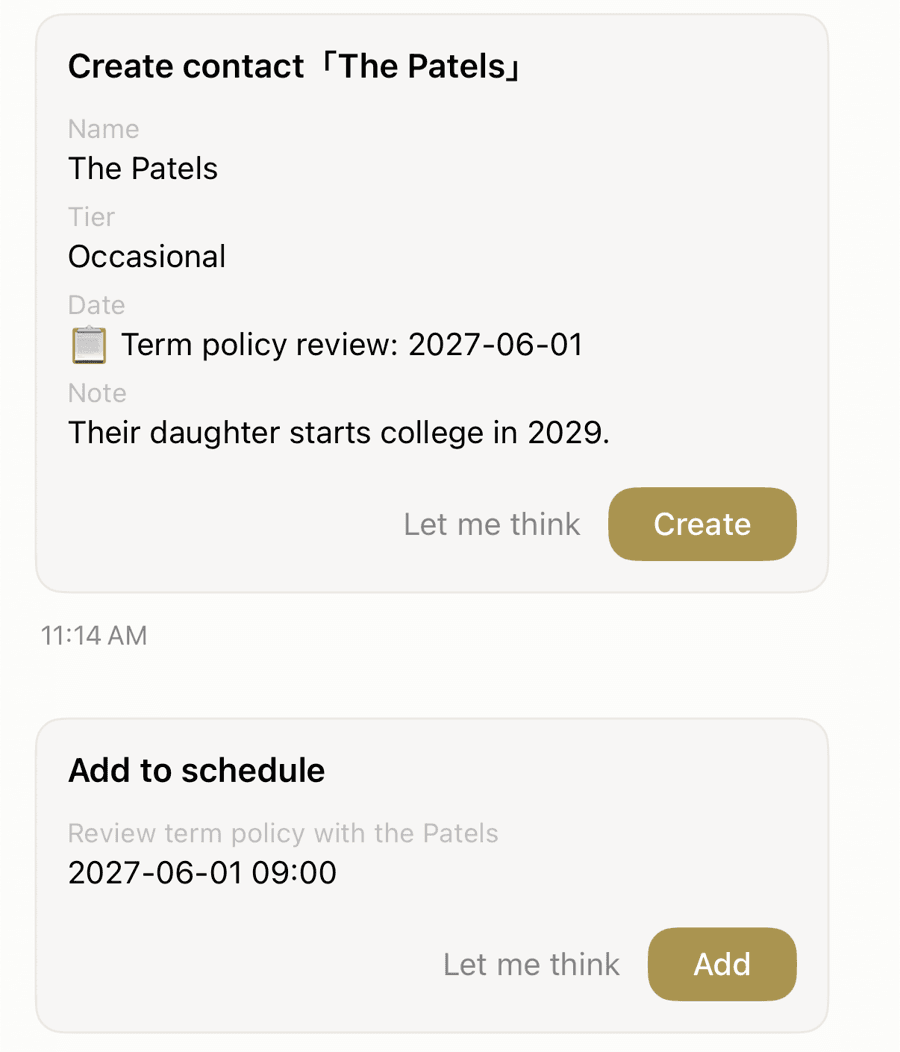
Fix in Codot: for the reviews that aren't on any carrier's calendar, say it once while you're still in the driveway. Term life doesn't renew every year, but the conversation should happen anyway:
"Every year on June 1 at 9, remind me to review the Patels' term policy. Their daughter starts college in 2029."
Codot proposes a contact card for the Patels with the term policy review as a key date and the college year as a note, plus a 9:00 entry on June 1; tap Create and Add to save both. Reminders at a set time, including repeating ones, are part of Codot Max.
2. Notes from the kitchen table never reach the CRM
The client mentions that her husband's company is cutting group life in January, that they want a second quote for her mother, and that they'll decide on the beneficiary after Thanksgiving. Renata nods, drives to the next appointment, and by evening remembers two of the three.
Fix: capture in the driveway, before the car moves, then type into the CRM later from a personal client log filled by voice instead of from memory. In Codot that's one sentence:
"Gloria Medina: husband loses his group life in January, wants a quote for her mother too, beneficiary decision after Thanksgiving. Call her December 1 at 6."
Codot files the details on Gloria's contact and sets the December 1 reminder. Notes on contacts and voice input are on the free plan.
Leave every identity and health detail out of the sentence: dates of birth, Social Security numbers, medications, anything from the application. Those go into the carrier's e-app or your insurance CRM, which are built to hold them.
3. A quote promised "by Thursday" goes out on Monday
The promise was made out loud, so it never became a CRM task. Fix: put every spoken promise on a clock, with two reminders for anything that matters.
"Send the Okonkwo final expense quotes by Thursday at noon. Remind me Wednesday at 4 and Thursday at 9."
Reminders at a set time are a Codot Max feature, and on iPhone with iOS 26 or later they can ring like an alarm. One habit worth knowing: Codot doesn't resend a reminder you ignore, which is why the two-reminder pattern helps.

4. Clients go quiet until another agent rewrites them
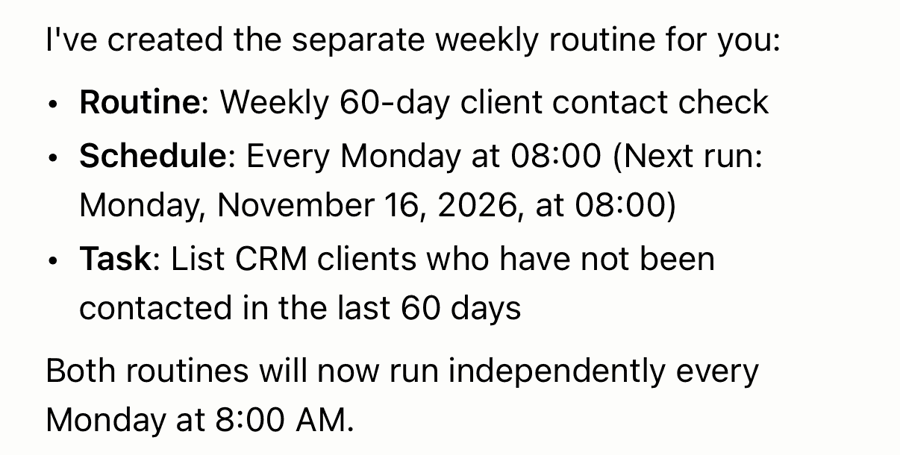
Nobody calls a client who is happy and paying. Three years later a competitor does. Fix in your CRM: a saved view of clients with no activity in 90 days. Fix in Codot: have the list come to you instead of waiting for you to open the view. A Routine is a scheduled automation:
"Every Monday at 8, list my clients I haven't contacted in 60 days."
Codot runs it on its own each Monday. Routines are part of Codot Max, and you can keep up to 20.
5. The CRM reminds you on a desktop you don't open in the car
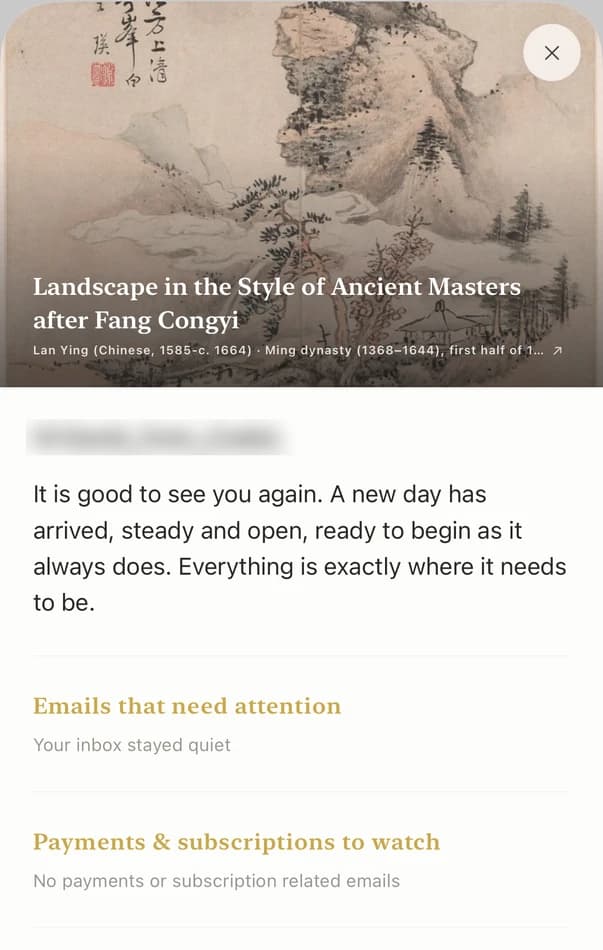
Many CRM reminders arrive as email or as a dashboard badge. Fix in your CRM: install its mobile app and turn on push notifications for tasks; HubSpot's iOS and Android app is described on its CRM page as built so you "never miss a task, reminder, or notification." Fix in Codot: on iPhone, Codot Max builds a daily brief at 7 a.m. with the day's reminders, so the Okonkwo quote and Gloria's callback are on one screen before the first coffee.
6. Referrals go cold before you call
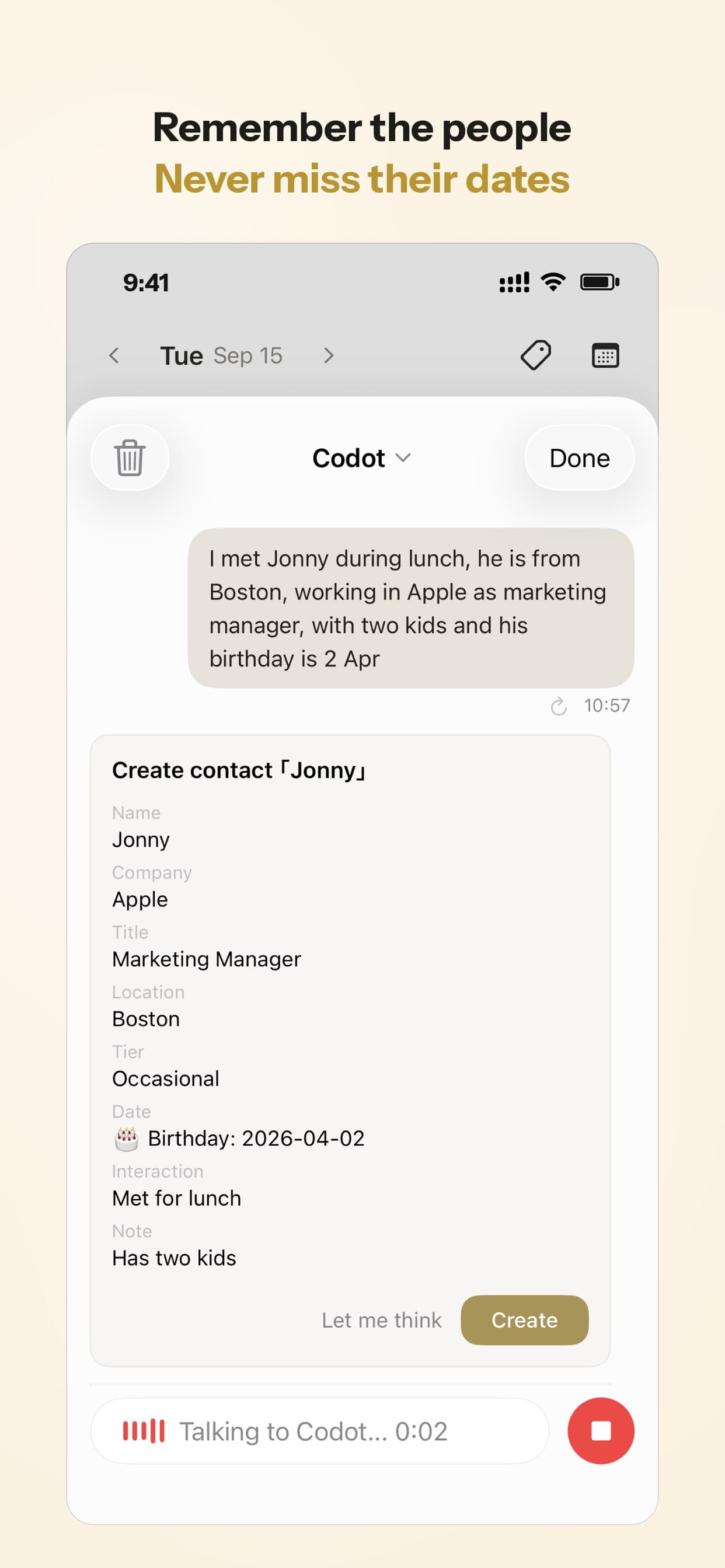
A client says her neighbor just had a baby and has no life insurance. The name goes on a sticky note. Fix: create the contact with who referred them and a call date in the same breath.
"New lead: Marcus Hale, Gloria Medina's neighbor, new baby, no life insurance. Referred by Gloria. Call him Tuesday at 5 and send Gloria a thank-you card this week."
Codot creates Marcus's contact with the referral, a Tuesday reminder and a thank-you task. When Marcus becomes a client, his record moves into your insurance CRM.
Your ideas shouldn't wait for a keyboard. Just say it — Codot handles the rest.
What is the best CRM for independent insurance agents?
Use Codot when your CRM is set up and renewals still slip, because the slips happen in the car, at the kitchen table and on the phone. Codot is a voice AI assistant for iPhone, Apple Watch, Android and the web. You say one sentence; it becomes a note on the person, a task, a reminder or a calendar entry.
For an independent life and health agent, the pairing works like this. The insurance CRM (AgencyBloc, Insureio or a set-up HubSpot) holds policies, carriers, applications and commissions. Codot holds what clients told you and when you promised to call, and it brings those back:
- Contact notes by voice: free.
- Reminders at a set time and repeating reviews like the Patels' June 1: Codot Max.
- A Monday Routine listing clients you haven't contacted in 60 days: Codot Max.
- The 7 a.m. daily brief on iPhone: Codot Max.
Every new account gets 7 days of Codot Max free, and it falls back to the free plan on its own if you don't subscribe, with nothing charged. After that it's $12.99 a month or $99.99 a year in the US App Store, with 20 times the free plan's usage. Codot doesn't sync with AgencyBloc, Insureio or HubSpot, so the evening step of moving notes into the CRM stays yours; a list beats memory for that.
What is the best free CRM for insurance agents?
HubSpot's free CRM is the strongest no-cost option for one or two agents: up to 2 users and 1,000 contacts with no time limit, and HubSpot's CRM page lists task tracking and an iOS and Android app. Zoho CRM's free edition covers 3 users. Both need you to add insurance fields yourself.
If you'd rather start with an insurance-built tool, Insureio's 30-day trial lets you load real quotes before paying $25 a month. And for the follow-up side, Codot's free plan keeps contact notes, tasks and the calendar; the timed reminders and Routines above come with the 7-day Max trial.
For more on the pieces: our roundup of personal CRM apps, how contractors choose a CRM on a similar budget, real estate follow-up text messages for every stage of a lead, and a field rep's day with the apps that fit each moment.
FAQ
What is the best CRM for life insurance agents?
For a solo life agent, Insureio (from $25 a month, as of November 2026) bundles life quoting, e-applications and contacts. If you also sell health and Medicare, look at AgencyBloc, whose AMS+ packages start at $109 a month.
Is Radiusbob still available?
Not for new agents. As of November 9, 2026, the Radiusbob website says it is no longer sold to new customers and points to AgencyBloc's AMS+, while existing users stay supported.
What is the best free CRM for insurance agents?
HubSpot's free CRM covers up to 2 users and 1,000 contacts, and Zoho CRM's free edition covers 3 users. Both are general-purpose, so you add renewal dates and policy fields yourself.
Can Codot replace my insurance CRM?
Codot works next to it. Codot captures what clients say and reminds you when to follow up, including policy review dates and a Monday list of clients you haven't called; quoting, applications, policy records and commissions stay in your insurance CRM.
How much does Codot cost for an insurance agent?
Contact notes, tasks, calendar and voice input are free. Timed and repeating reminders, Routines and the iPhone daily brief are Codot Max at $12.99 a month or $99.99 a year in the US, with a 7-day free trial for every new account.
Try the Monday Routine and the driveway sentence for a week on the 7-day Codot Max trial: download Codot on the App Store.
Founders & Professionals Desk
This article was created with AI assistance and reviewed by our editorial team.Learn about our content process.