Best CRM for Mortgage Loan Officers (2026): One Small-Shop LO's Week, Day by Day
What a mortgage CRM does, which ones loan officers shortlist (Shape, Surefire, Total Expert, free HubSpot), and the follow-ups a voice assistant catches in one week.
The best CRM for a mortgage loan officer is usually two layers. A mortgage CRM such as Shape, Surefire or Total Expert holds borrower records and drip campaigns, and HubSpot's free CRM covers up to two users and 1,000 contacts. Codot, a voice AI assistant for iPhone, adds the follow-up layer: one spoken sentence becomes a contact note and a timed reminder. Codot Max costs $12.99 a month.
Disclosure: Codot is our product. Dana, the loan officer below, is fictional, and her week is a composite written to show where each tool fits. Facts about other CRMs come from each company's own website, checked November 9, 2026.
TL;DR:
- A mortgage CRM is the company's record: borrower contacts, leads, drip campaigns, co-marketing with realtors. Shape, ICE's Surefire and Total Expert are built for mortgage and sell through demos; none of the three publishes a price.
- On a budget, HubSpot's free CRM covers up to two users and 1,000 contacts, with paid seats from $15 a month.
- What slips for a small-shop loan officer is rarely in the CRM: what a realtor said over coffee, a pre-approval about to expire, the past client who'd want a call when rates move.
- Codot catches those for $12.99 a month: say one sentence and it becomes a note on the contact, a reminder at the time you name, a yearly loan-anniversary call, or a Friday list of past clients who have gone quiet.
At a glance
| CRM | Best for | Price (as of Nov 2026) | What it does | Main limit | Source |
|---|---|---|---|---|---|
| Shape | Loan officers and lenders who want CRM and point of sale in one | No public price; demo first | Mortgage CRM, lead management, built-in POS, call/text/email, mobile app | You book a demo before you see a number | setshape.com |
| Surefire (ICE Mortgage Technology) | Shops that live on automated borrower marketing | No public price; "Get started" form | Automated outreach from first contact through funding and after closing | Marketing-first; ask about mobile capture | mortgagetech.ice.com |
| Total Expert | Larger lenders and banks | No public price; demo first | Customer platform for financial services: campaigns, co-marketing, consent, mobile app | Built for company rollouts, not one LO | totalexpert.com |
| HubSpot (free CRM) | A solo LO starting with nothing | Free for up to 2 users and 1,000 contacts; paid from $15 a month per seat | General CRM with contacts, deals, email and a mobile app | No mortgage-specific features or LOS link | hubspot.com |
| Codot | The LO's own follow-ups, said out loud | Free plan; Codot Max $12.99 a month or $99.99 a year | Voice notes on contacts, timed and repeating reminders, routines, morning brief, email triage | Sits next to the company CRM; doesn't sync with it | codot.ai/pricing |
BNTouch and Jungo show up on most loan officer shortlists too. Their sites didn't load for us on November 9 (a security check on one, a server error on the other), so we left them out of the table instead of quoting second-hand prices.
What is a CRM in mortgage, and why do loan officers end up with two?
In mortgage, CRM means the customer relationship management system that holds your borrowers, prospects and referral partners. A mortgage CRM adds things a general CRM lacks: loan-stage triggers, rate and anniversary campaigns, co-branded marketing with realtors, and links to the loan origination system (LOS).
That system is usually chosen by the company, and it's built around the file. It's very good at sending the 30-day-after-closing email to every borrower, though you might prefer sending real estate follow-up text messages for a more personal touch. It's weaker at the moment a loan officer actually lives in: walking out of a coffee with a realtor, with three details in your head and a call to make on Tuesday.
So most loan officers keep a second layer anyway. Sticky notes, texts to themselves, a voice memo nobody replays. The trouble with all of them is that nothing comes back on its own.
Keep the split clean. The company LOS and CRM stay the record for borrower files, disclosures and marketing. A personal app holds relationship details and reminders. Ask your company what it allows in personal apps; we'd keep loan numbers, income figures and Social Security numbers out of Codot entirely.
What does one loan officer's week look like with a follow-up layer?
Dana is a loan officer at a three-person independent mortgage shop: two LOs and a processor. Her company pays for a mortgage CRM. She has about 300 past clients and six realtor partners who send her most of her purchase business. This is one week in November, with Codot set up the Sunday before.
Monday, November 16, 7:00 a.m.: the brief
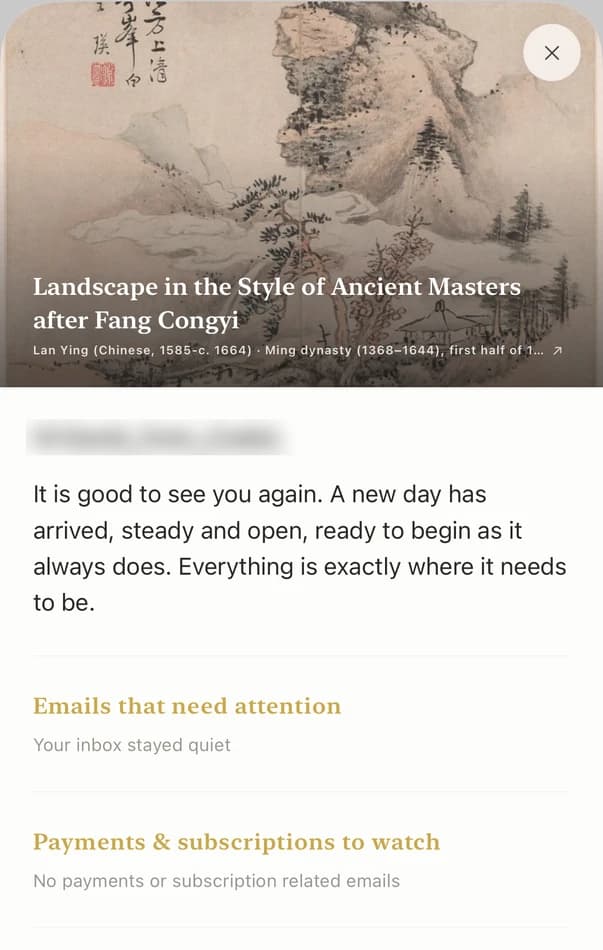
Her iPhone shows Codot's morning brief before she's out of bed: the Lins' pre-approval expires Friday, coffee with Ken from Harbor Realty Tuesday at 8, and a 4 p.m. reminder to look at rates for three borrowers who were waiting.
Monday, 10:40 a.m.: rates dip
Rates move down mid-morning. Three borrowers told her over the past month to call when that happened, and each time she said a sentence into Codot right after the call: "Tom Reyes, refi, wants a call if rates drop, wife Ana handles the paperwork." The note sat on Tom's contact. Now she asks Codot "what do I know about Tom Reyes?" before dialing, and says: "Remind me at 4 to call the Patels and the Nguyens about today's rates."
Tuesday, 8:50 a.m.: after coffee with a realtor partner
Ken has two first-time buyers coming in December and wants a co-branded open house flyer. His daughter just started at the state university. In the car, before she pulls out, Dana says:
"Ken at Harbor Realty: two first-time buyers in December, wants a co-branded flyer for the Elm Street open house, daughter just started at State. Remind me Thursday at 10 to send the flyer."
The note lands on Ken's contact and the reminder is set for Thursday.
Wednesday, 9:00 a.m.: a pre-approval about to expire
Ninety days ago, when she issued the Lins' pre-approval letter, Dana said: "The Lins' pre-approval expires November 20. Remind me November 18 at 9 and November 19 at 9." Codot doesn't resend a reminder you ignore, so she sets two for anything with a deadline. The first one fires now; she calls the Lins about updated pay stubs while there's still time to reissue.

Thursday, 9:00 a.m.: a past client's loan anniversary
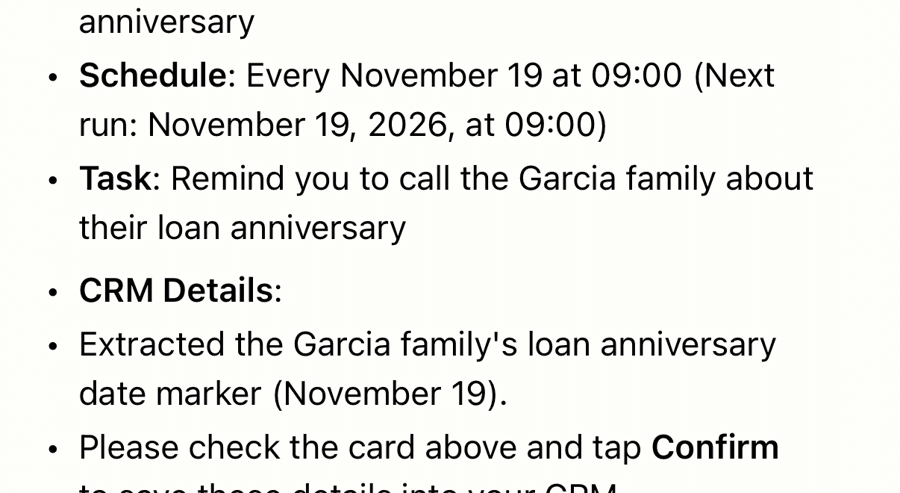
The Garcias closed on November 19, 2024. When they did, Dana said: "Every year on November 19 at 9, remind me to call the Garcias about their loan anniversary." The call takes six minutes. They mention their daughter wants to buy a condo next spring, so Dana adds: "Garcias' daughter Sofia wants to buy a condo next spring, call her in February." That's a new contact and a new reminder, from one call.
Friday, 4:00 p.m.: who has gone quiet
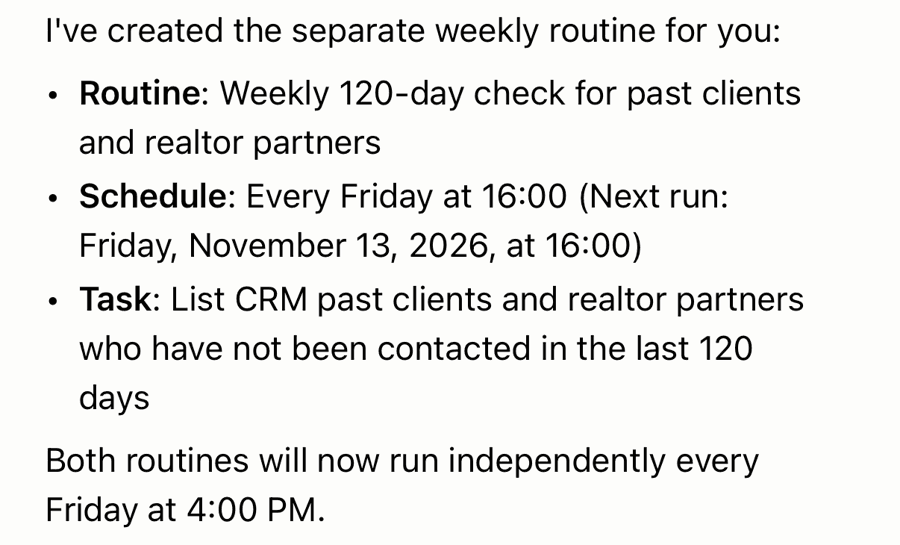
A routine she set up on Sunday runs on its own: "Every Friday at 4, list my past clients and realtor partners I haven't contacted in 120 days." Today's list has seven names. She texts four of them before leaving the office and moves the rest to Monday by saying so.
Saturday: the inbox
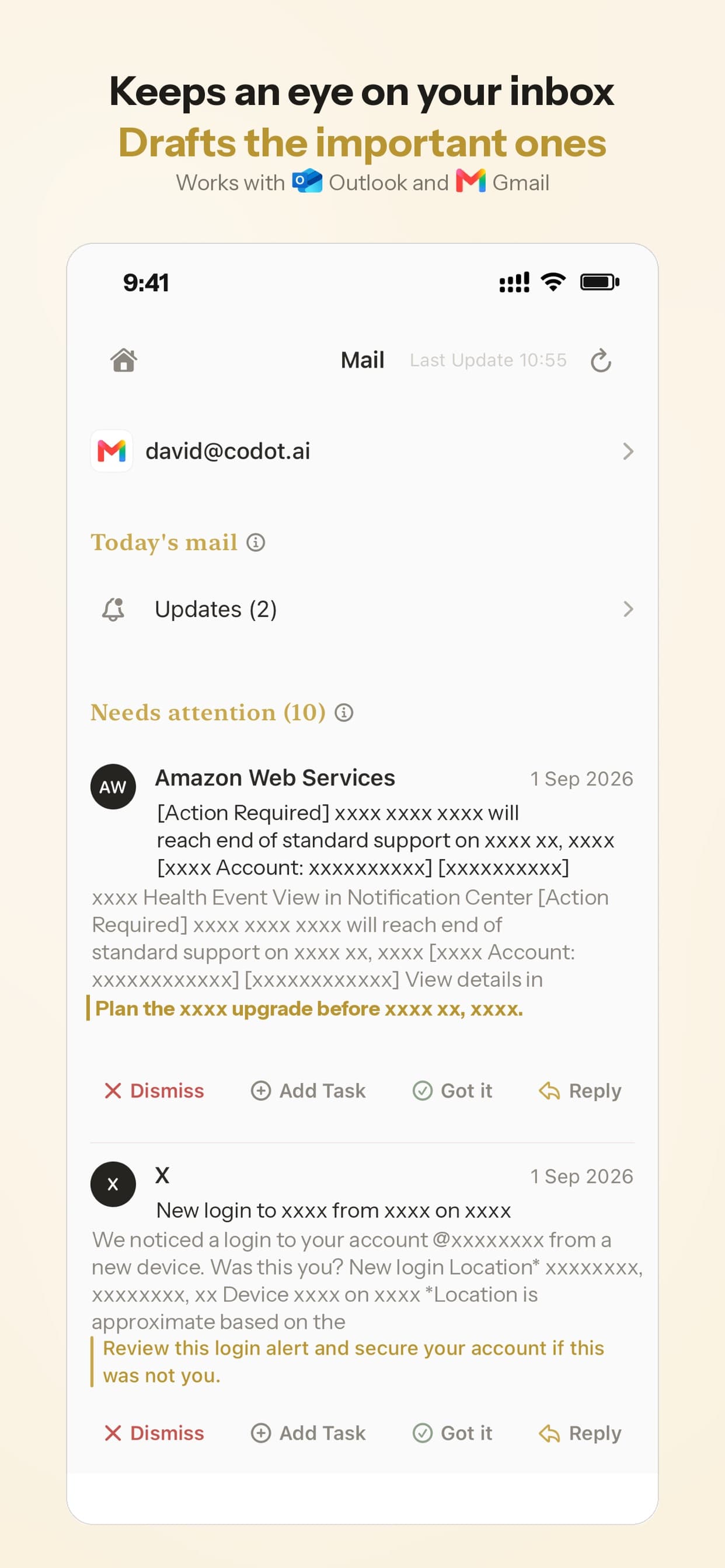
Codot's email assistant on iPhone sorts her Gmail and drafts replies to the messages that matter. Two realtor emails and one from a title company float to the top; she edits the drafts and sends them in ten minutes. Borrower documents still go through the company's secure portal.
None of this replaced the company CRM. The drip emails, the borrower file and the rate-alert campaign still ran from there.
What is the best CRM for mortgage loan officers in a small shop?
Use Codot when your follow-ups depend on you remembering them: what a realtor partner said, when a pre-approval runs out, which past client is due a call. Codot is a voice AI assistant for iPhone, Apple Watch, Android and the web, and it works as the loan officer's own layer next to whatever CRM the company runs.
- Contact notes by voice (free). Say who you talked to and what they said, and Codot files it on that person's contact. Ask "what do I know about Ken?" before the next coffee. The personal CRM, voice input, tasks and notes are on the free plan.
- Reminders at a set time, and repeating ones (Codot Max). "Remind me November 18 at 9" for a deadline, "every year on November 19" for a loan anniversary. Natural periods work, such as "every quarter on the 15th". Codot writes these into Google Calendar or Apple Calendar; it doesn't read the events already there.
- Routines (Codot Max). A routine is a scheduled automation, such as "every Friday at 4, list contacts I haven't talked to in 120 days." You can keep up to 20, so a second one might be "every other Tuesday at 8, list my realtor partners."
- A morning brief on iPhone (Codot Max). Generated at 7 a.m. with the day's reminders.
- Email triage and draft replies on iPhone (Codot Max). One Gmail and one Outlook account per user.
We'd start with the 7-day free trial of Codot Max that every new account gets. It falls back to the free plan on its own, and nothing is charged. After that, Codot Max is $12.99 a month or $99.99 a year in the US App Store, with 20 times the free plan's usage.
Your ideas shouldn't wait for a keyboard. Just say it — Codot handles the rest.
Which mortgage CRM should hold the record?
Pick the record by who runs it and how much marketing you want automated.
Shape calls itself an AI CRM for loan officers and lenders. Its mortgage page lists "Mortgage CRM, lead management + built-in POS" and a "Mobile app for loan officers on the go" (setshape.com). There's no price on the site; you get one after a demo.
Surefire, from ICE Mortgage Technology, leads with marketing: the product page says "Automate your mortgage marketing and deepen relationships through one powerful solution," with outreach from first contact through funding and after closing (ICE). It suits shops that want past clients and realtors on automated campaigns. No price is published.
Total Expert describes itself as "The Customer Operating System for Financial Services" and lists co-marketing, consent tools and a mobile app (totalexpert.com). It's priced and sold to companies, so a single LO rarely buys it alone.
If your company already pays for one of these, use it. A solo LO picking for themselves usually weighs a demo-priced mortgage CRM against a free general one.
Is there a free CRM for mortgage loan officers?
HubSpot's free CRM is the usual answer. HubSpot says it covers "up to two users, 1,000 contacts" at no cost, with paid seats starting at $15 a month (hubspot.com). It has contacts, deals, email tracking and a mobile app. It has no mortgage-specific campaigns and no link to an LOS, so you'd build your own pipeline stages.
Codot's free plan covers contact notes by voice, tasks and the calendar. Pairing the two costs nothing to start: HubSpot holds the pipeline, Codot holds what people told you. Add Codot Max when you want the reminders and routines.
How should a loan officer choose?
- You lose follow-ups with realtors and past clients: start with Codot next to whatever CRM you have.
- You want borrower marketing on autopilot: ask Shape and Surefire for demos and compare their quotes.
- You're at a larger lender: Total Expert is built for company-wide rollouts.
- You're solo and budget comes first: HubSpot's free CRM plus Codot's free plan.
Codot is best at what you say and when you need to hear it again. Keep the company CRM or LOS for borrower files, campaigns and anything compliance needs to see, since Codot doesn't sync with mortgage CRMs or answer calls.
More on the same pattern in other trades: a solo realtor's week with and without help, our roundup of personal CRM apps, the best CRM for contractors, the best CRM for insurance agents, the best CRM for photographers, and an outside sales rep's day.
FAQ
What is the best CRM for mortgage loan officers?
For the company record, loan officers most often shortlist Shape, Surefire and Total Expert, all of which price by demo as of November 2026. For the loan officer's own follow-ups, Codot turns a spoken sentence into a contact note and a timed reminder; Codot Max is $12.99 a month.
Is there a free CRM for mortgage loan officers?
HubSpot's free CRM covers up to two users and 1,000 contacts with no time limit. Codot's free plan adds voice notes on contacts, tasks and a calendar. Neither is mortgage-specific.
What does CRM mean in mortgage?
CRM stands for customer relationship management. In mortgage it's the system that stores borrowers, prospects and realtor partners and runs follow-up campaigns, often linked to the loan origination system.
Can Codot replace my company's mortgage CRM?
Codot works alongside it. Use Codot to capture what borrowers and realtors tell you and to get reminders on your phone; keep the company CRM or LOS as the record for borrower files and marketing. The two don't sync.
Can Codot remind me about a client's loan anniversary every year?
Yes. Say "every year on November 19 at 9, remind me to call the Garcias about their loan anniversary" and Codot repeats it yearly. Repeating reminders are part of Codot Max, which every new account can try free for 7 days.
Try Codot free for 7 days with Codot Max included: download Codot on the App Store.
Founders & Professionals Desk
This article was created with AI assistance and reviewed by our editorial team.Learn about our content process.