ADHD and Keeping in Touch With Friends (2026): A Copyable Friend List, 12 Check-In Lines and Two Reminders That Do the Remembering
ADHD and keeping in touch with friends: a copyable friend list, 12 short check-in lines and two voice-set reminders so friends don't drop out of sight.
Keeping in touch with friends is hard with ADHD because people who aren't in front of you stop feeling urgent, not because you care less. A short friend list plus a weekly reminder fixes most of it. Codot, a voice AI assistant for iPhone, can save notes on each friend for free and, with Codot Max ($12.99 a month, 7-day free trial), list every Sunday the friends you haven't been in touch with for two weeks.
Disclosure: Codot is our product. Imani below is fictional, used to show how each part of the system works. Codot features and prices are from codot.ai, checked November 2026.
TL;DR:
- If friends drift because you forget they exist between visits, you're describing a memory and timing problem, and it responds to the same fix as any other: write it outside your head and get asked on a schedule.
- This page is a kit you can copy: a friend list template (eight columns, fill it in 15 minutes), 12 check-in lines that take under a minute to send, and a monthly checklist.
- Two reminders do most of the work: a weekly "who haven't I talked to?" list and a yearly reminder for each birthday you care about.
- Use Codot when you'd rather say "Dee is moving to Leeds in March" out loud after coffee than open a spreadsheet, and want a Sunday list of who's gone quiet without building one.
At a glance
- CHADD, the US ADHD advocacy organization, suggests keeping notes on friends' interests and the people important to them, and reading them before you next meet (CHADD, Maintaining Friendships).
- The same CHADD article points out that when you can't add to shared memories, friends may conclude you aren't interested, even when you are (CHADD).
- Codot: contacts with notes, voice input and shared lists with friends are free. Timed and repeating reminders, the 7:00 daily briefing (iPhone) and scheduled Routines (up to 20) are Codot Max, $12.99 a month or $99.99 a year, with 20x the free plan's usage (codot.ai).
Why do people with ADHD lose touch with friends they care about?
People with ADHD lose touch because a friend who isn't in the room stops producing any signal, and ADHD runs on signals. Online this gets called "out of sight, out of mind" or "object permanence with people". It isn't a clinical term, but it describes the pattern well: you love Dee, you think of her when you pass her favourite café, and then nothing reminds you for four months.
The guilt makes it worse. The longer the gap, the bigger the message feels, so the gap grows. CHADD's point about shared memories is the part that hurts: a friend can't see your intentions, only your silence.
The fix isn't trying harder to remember. It's giving the remembering to a list and a clock, and making each check-in small enough to send while the kettle boils.
The friend list template (copy this)
Fill this in once, in about 15 minutes. Six to twelve people is enough; this is for the friends you'd be sad to lose, not everyone you know.
| Name | How we know each other | What's going on in their life | Last real contact | Easy next touch | Rhythm | Birthday | Note to self |
|---|---|---|---|---|---|---|---|
| Dee | University | Moving to Leeds in March; new job at a museum | Coffee, Nov 9 | Ask how the flat hunt is going | Every 2 weeks | June 14 | Hates phone calls, loves voice notes |
| Sam | Old flatmate | Training for a half marathon in April | Text, Oct 2 | Send a running meme | Monthly | Feb 3 | Free on Sunday mornings |
| Aunt Rosa | Family | Knee surgery recovery | Call, Sep 20 | Call on Sunday, 10 minutes | Monthly | Aug 30 | Call, don't text |
Three columns do the heavy lifting. "What's going on in their life" turns a check-in from "hey, long time!" into a real question. "Easy next touch" removes the blank-page moment. "Rhythm" is your honest answer, not your ideal: every two weeks for two or three people, monthly for most, quarterly for the rest.
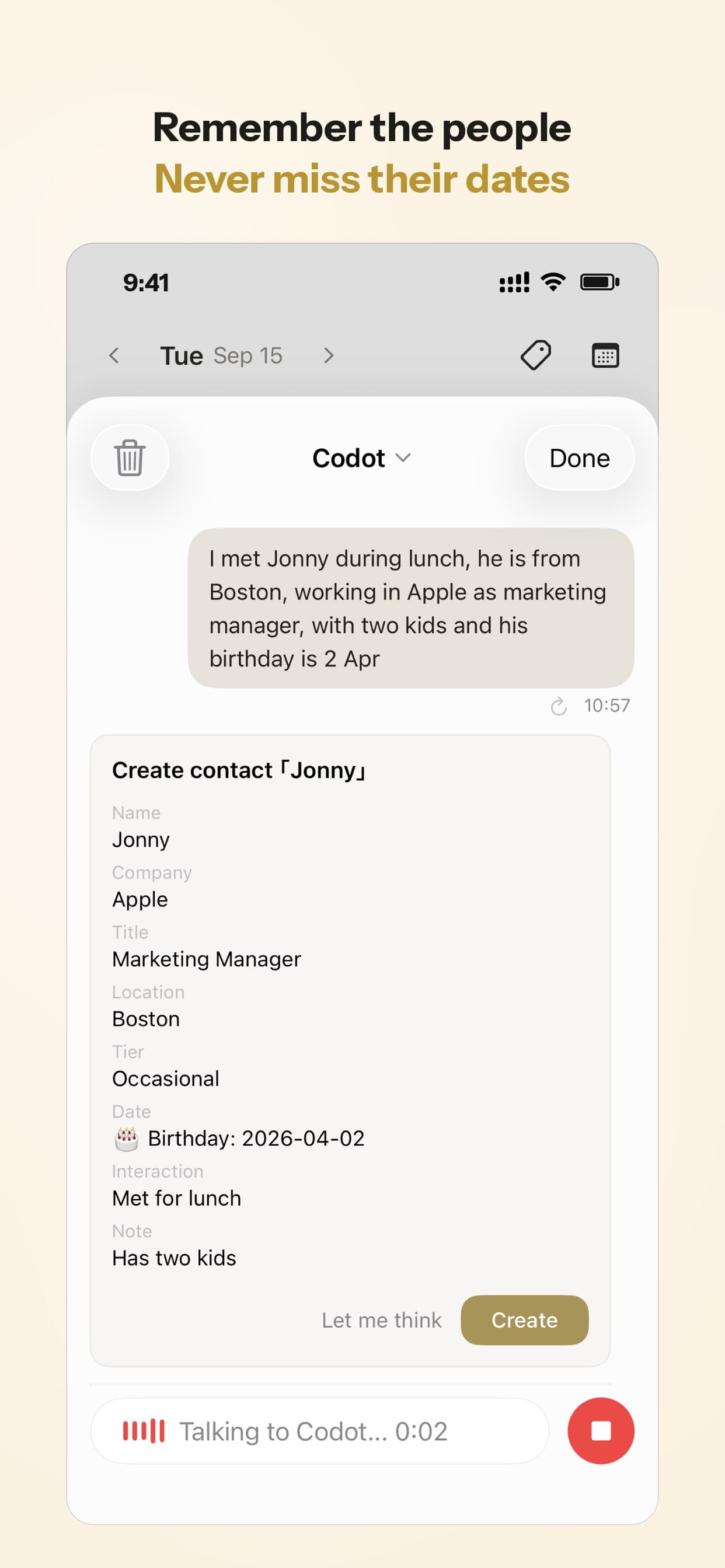
If you'd rather not keep a spreadsheet, the same columns fit on a contact card. In Codot you can say it instead of typing it:
"Dee: moving to Leeds in March, new job at the museum, hates phone calls, loves voice notes. Birthday June 14."
12 check-in lines that take under a minute
Copy these into your notes app. Each one works after a gap of any length, and none of them asks for an explanation.
When you know what's going on in their life
- "Thinking about you and the Leeds move. Found a flat yet?"
- "How did the half marathon training go this week?"
- "Saw this and thought of you" + a link, a photo or a song.
- "How's the knee? No need to reply if you're tired."
When it's been a long time
- "I've been bad at texting, but I think about you a lot. How are you, really?"
- "No catch-up essay needed. What's one good thing from this month?"
- "I miss you. Free for a walk or a call in the next two weeks?"
When you want to see them
- "Coffee on Saturday at 11, same place as last time?"
- "I'm in your area on Thursday afternoon. Want a quick walk?"
- "Can we put a date in now so I don't drift? First Sunday of next month?"
When texting feels like too much
- A 20-second voice note: "Just walking past the café, thought of you."
- A reaction to their story or post, plus one question.
Line 10 is the most useful habit on this page: book the next meetup before you leave the current one.
Your ideas shouldn't wait for a keyboard. Just say it — Codot handles the rest.
The monthly keep-in-touch checklist
Print it or paste it into a note. Ten minutes on the first Sunday of the month.
- [ ] Read the friend list top to bottom.
- [ ] Anyone past their rhythm? Send one line from the list above. Don't wait for the perfect message.
- [ ] Add anything new you learned this month to their row or card (job, move, kid, illness, trip).
- [ ] Birthdays in the next 30 days? Set a reminder for the day before.
- [ ] One person to actually see this month: send line 8 or 9.
- [ ] Anyone who has drifted for good? Move them to "quarterly". That's allowed.
What app helps with ADHD and keeping in touch with friends?
Use Codot when your friend notes live in your head, you'd rather speak than fill in a template, and you want to be told on Sunday who has gone quiet. Codot is a voice AI assistant for iPhone (also Android, web and Apple Watch). Contacts, notes on each person, tasks, your calendar and reminders all sit in one app, and one sentence can update several of them at once.
Here is how Imani, a fictional freelance illustrator, runs her friend list with three sentences.
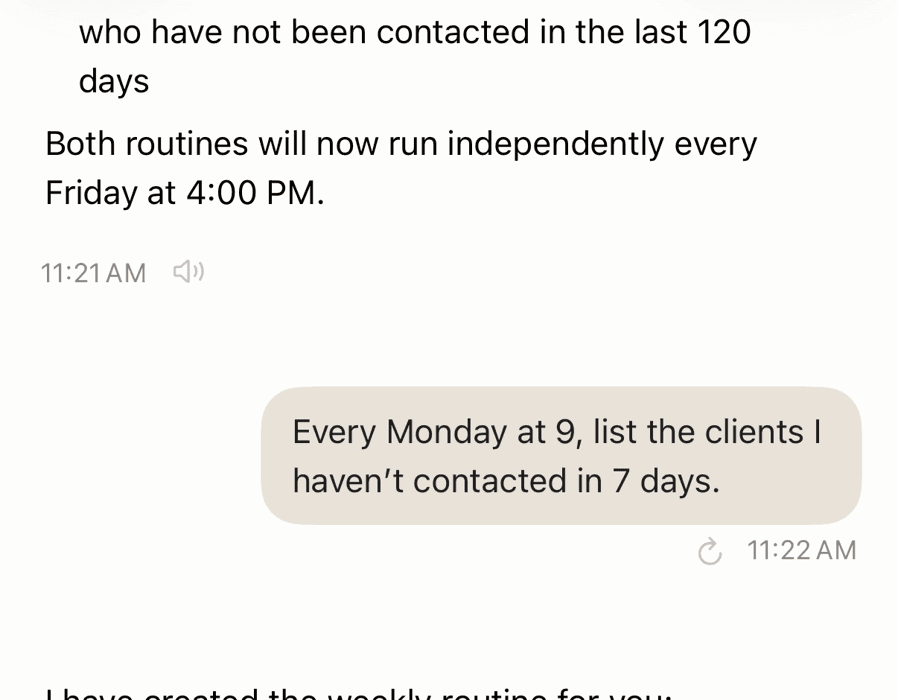
Sunday evening, once: the weekly list. Imani says:
"Every Sunday at 7 pm, list the friends in my contacts I haven't been in touch with for 14 days."
Codot sets it up as a Routine, a scheduled automation that runs whether or not she opens the app. Routines are Codot Max. The list is only as good as what Codot knows, so the habit that feeds it is one sentence after each catch-up.
Saturday 12:40, after coffee with Dee: one sentence, three changes. Walking to the bus, Imani says:
"Had coffee with Dee today, she got the museum job and moves to Leeds March 1. Remind me February 25 to send her a good-luck voice note, and every year on June 13 at 6 pm remind me Dee's birthday is tomorrow."
Codot adds the news to Dee's contact card, sets a timed reminder for February 25 and creates a yearly reminder for June 13. That's a note, a one-off reminder and a repeating reminder from one sentence, said in about 15 seconds. The two reminders are Codot Max; the contact note is free.
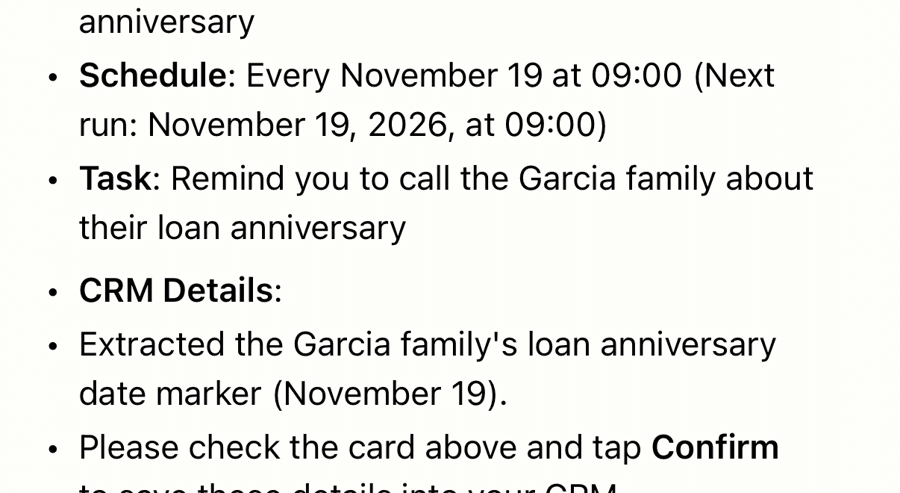
Wednesday 21:15, a plan with a friend that doesn't depend on her memory. Imani and Sam keep saying "we should run together". Sam uses Codot too, so they're friends in the app, and Imani says:
"Remind Sam and me on the first Saturday of every month at 10 am to pick a date for a run."
The reminder lands on both phones every month, not just the first time; Imani taps Confirm on the share card once. Adding friends and sharing tasks is free; making it repeat is Codot Max.
Before she meets someone, Imani can ask "what's going on with Sam?" and get back what she said last time, which is the CHADD advice (read your notes before you meet) without a notebook. If she wants the morning view, the 7:00 daily briefing on iPhone shows the day's reminders, including "Dee's birthday is tomorrow".
Codot handles the remembering and the reminding. It doesn't send texts to your friends for you; you still write the message, which is the part that matters to them. If you also want a dedicated personal CRM such as Dex for a large network, Codot can sit beside it for the friends you talk about out loud.
How should you restart a friendship after months of silence?
Restart it with one short message that asks about their life and asks nothing of them. Skip the apology paragraph; a single line like "I've been bad at texting, but I think about you a lot. How are you, really?" covers it. Most friends read a long gap as "busy", not as rejection, and a long explanation makes the reply feel like work.
Then put the next contact on a schedule before the conversation ends, either a date in the calendar or a reminder to check in two weeks later. The second message is the one that usually doesn't happen.
If you want the broader system behind this, our guide to ADHD and forgetting things the second you think of them covers capture, the voice CRM for ADHD networking applies the same contact-card idea to work contacts, and our shared reminders for ADHD couples setup brings the same idea home for dinners, birthdays and pickups.
FAQ
Why do I forget to text my friends back with ADHD?
With ADHD, a message you meant to answer later loses its pull as soon as it scrolls out of view. Replying in the moment, or saying "remind me at 8 to reply to Sam" to an assistant like Codot (a Codot Max timed reminder), fixes most missed replies.
Is "object permanence" with friends a real ADHD symptom?
"Object permanence" is a child-development term, and ADHD clinicians don't diagnose it in adults. People use it to describe how someone out of sight stops coming to mind. The practical answer is the same either way: an external list and a scheduled reminder.
What is the best app to remind me to keep in touch with friends?
Codot works well if you want to speak instead of type: free contact notes on each friend, plus a Codot Max Routine that lists every Sunday who you haven't been in touch with for two weeks. Calendar reminders work too if you're happy to set each one by hand.
Can Codot remind me of my friends' birthdays every year?
Yes. Say "every year on June 13 at 6 pm remind me Dee's birthday is tomorrow" and Codot creates a yearly reminder; repeating reminders are part of Codot Max, and the birthday itself can also be saved on the contact card for free.
How often should I check in with friends if I have ADHD?
Pick a rhythm you'll actually keep: every two weeks for two or three close friends, monthly for most, quarterly for the rest. Writing the rhythm next to each name, on a list or on a Codot contact card, matters more than the exact number.
Codot is free to start on the App Store, and every new account gets 7 days of Codot Max to try the Sunday list and the birthday reminders.
ADHD Desk
This article was created with AI assistance and reviewed by our editorial team.Learn about our content process.