Starting Your Winter Arc in November (2026): An 8-Week Plan That Survives Week 3
A Winter Arc 2026 plan that starts in November: 3–4 rules, a weekly schedule, what to do when motivation drops in week 3, and how to get through Christmas.
Yes, you can start a Winter Arc in November. Run it for eight weeks, from Monday, November 9 to Sunday, January 3, with three or four daily rules instead of a long list. Log missed days without restarting, plan a lighter week 3 in advance, and decide before December which holiday days are rest days.
TL;DR:
- The Winter Arc is a self-improvement season from social media, usually October 1 to December 31. This plan starts late and runs eight weeks, November 9 to January 3.
- Pick 3 or 4 rules, each with a minimum version for bad days.
- Week 3 (November 23–29) is also US Thanksgiving week. Plan it as a minimum week in advance.
- Christmas: choose rest days before December 1. Unlike 75 Hard, there's no restart rule, so log a miss and carry on.
- Codot (ours) is the life buddy option: say the plan once on Sunday night and it becomes habits, workout and study blocks, a 7am briefing and a 9pm check-in. When a week falls apart, you say so and it re-plans.
Disclosure: Codot is our product. Facts about the Winter Arc, 75 Hard and the Great Lock In come from the dated pages we link, checked November 3, 2026. The plan is our recommendation; we haven't tested it on anyone.
What the Winter Arc is (and why "late" doesn't matter)
The Winter Arc is a TikTok trend that took off in autumn 2024. Dexerto's explainer from October 7, 2024 describes it as treating October 1 as a fresh start and spending the next three months building mental, physical and spiritual habits, and it says one creator's video about her arc passed 4.3 million views. In the "arc" framing, you're the character who comes back changed at the end of the season.
For 2026, Takeroon's guide (September 12) gives October 1 to December 31 and notes some people start November 1, and GainFrame's planner (September 19) counts day 1 from whatever date you begin.
There is no official rule list. The trend is a shared deadline (the end of the year) plus a shared story, so starting in November costs you nothing except a few weeks.
Pick 3–4 Winter Arc rules, not 12
Long Winter Arc checklists (wake at 5, cold shower, two workouts, no sugar, journal) turn one bad Tuesday into a failed arc.
We'd cap it at four rules, each with a full version and a minimum version you can do on a bad day:
| Rule | Full version | Minimum version |
|---|---|---|
| Body | Gym Mon / Wed / Fri, walk 30 min on other days | 10-minute walk |
| Main goal | One 60-minute block: study, job applications, side project | 15 minutes on the same thing |
| Sleep / phone | Phone on the charger outside the bedroom by 10:30pm | Phone off the bed by 11 |
| Optional | 10 pages of a book, or log meals | 2 pages |
A good rule has a time or a number in it, so you can tell at 9pm whether you did it. "Eat better" can't be checked. "Lunch from home on weekdays" can.
Winter Arc for students: make the main goal your hardest class, at the same time every day. December exams fall in weeks 5–6, so the study block grows there and the body rule drops to its minimum.
Winter Arc for beginners: start with two rules in week 1 and add the third in week 2.
The 8-week Winter Arc schedule (November 9 – January 3)
| Week | Dates | Focus |
|---|---|---|
| Setup | Sun Nov 8 | Write the rules, put every block on the calendar |
| 1 | Nov 9–15 | Two rules only. Get the times right |
| 2 | Nov 16–22 | Add rule three |
| 3 | Nov 23–29 | Planned minimum week (see below) |
| 4 | Nov 30–Dec 6 | Back to full versions; first honest review |
| 5 | Dec 7–13 | Exams / year-end deadlines: main goal up, body to minimum if needed |
| 6 | Dec 14–20 | Hardest full week. Same rules, no new ones |
| 7 | Dec 21–27 | Holiday week: pre-chosen rest days |
| 8 | Dec 28–Jan 3 | Finish and write down what carries into January |
A weekday Winter Arc routine: wake at 7, gym or walk before work or class, the 60-minute block at a fixed time, phone out of the bedroom by 10:30. Sunday evening is a 15-minute review of last week's misses.
Week 3: what to do when motivation drops
Week 3 is usually when the novelty is gone and results aren't visible yet. Here it's November 23–29, which in the US is also Thanksgiving week.
Plan it as a minimum week before it starts:
- Switch every rule to its minimum version for the whole week. Doing the 10-minute walk on Thanksgiving counts as a kept rule.
- Log misses instead of restarting. Takeroon's guide makes the same point: write the miss down and keep going, and treat two misses in a row as a sign the rule or the timing is wrong. We agree. A restart rule gives you a reason to quit on day 40.
- Move the time, keep the rule. If the 8pm study block keeps failing, try 7am for a week.
If week 3 goes badly anyway, start week 4 on full versions as planned. The count carries on from day 22.
Christmas break without "failing"
Takeroon's guide flags December 26–31 as the stretch where many arcs quietly end. Classes and work stop, you sleep somewhere else, and the structure your normal week gave you for free disappears for six days.
Decide before December 1:
- Which days are rest days. For example December 24, 25 and 31. Rest days written into the plan count as following the plan.
- One rule you keep every day regardless. Usually the walk. It's portable and it works at a relative's house.
- When the arc restarts at full strength. Monday, December 28 is a natural point, so week 8 ends the year on full versions.
At the end of week 8, write down the one rule you'll keep running in January, with its time.
Your ideas shouldn't wait for a keyboard. Just say it — Codot handles the rest.
Winter Arc vs 75 Hard
People often compare the two, but they're built differently. 75 Hard is a specific program with official rules from Andy Frisella. According to the official 75 HARD rules page (checked November 3, 2026), every day for 75 days you follow a diet with no alcohol or cheat meals, do two 45-minute workouts with one of them outdoors, drink a gallon of water, read 10 pages of a non-fiction book and take a progress photo. Missing any task means starting again from day 1.
| Winter Arc | 75 Hard | |
|---|---|---|
| Rules | You choose them | Five fixed daily tasks |
| Length | Usually October to the end of December; flexible | 75 days |
| Missed day | Log it and continue (common advice) | Restart from day 1 |
| Start date | Anytime; the deadline is the end of the year | Any day you begin |
75 Hard suits people who want someone else's rules and an all-or-nothing test. If you're fitting this around classes, a job or kids, we'd pick a Winter Arc with four rules you wrote yourself, especially if you've already quit a strict challenge once.
And the Great Lock In?
The Great Lock In was the 2025 version of the same idea. Fortune described it in September 2025 as a Gen Z trend of treating autumn as a focused period for career, money or a personal brand, and Cal Newport wrote about it as using the last four months of the year for goals people would otherwise push to January. It leaned toward work goals; the Winter Arc leans toward body and habits. The plan above works for either.
Codot: say your Winter Arc plan once on Sunday night
In our view, the weak point of a self-run arc is that by week 3 the person keeping track is also the person who's tired. Codot is a voice-first AI assistant: you say what you want in one sentence, and it creates the tasks, calendar events, habits, reminders and scheduled check-ins. For a Winter Arc, that makes it a life buddy that holds the structure for you.
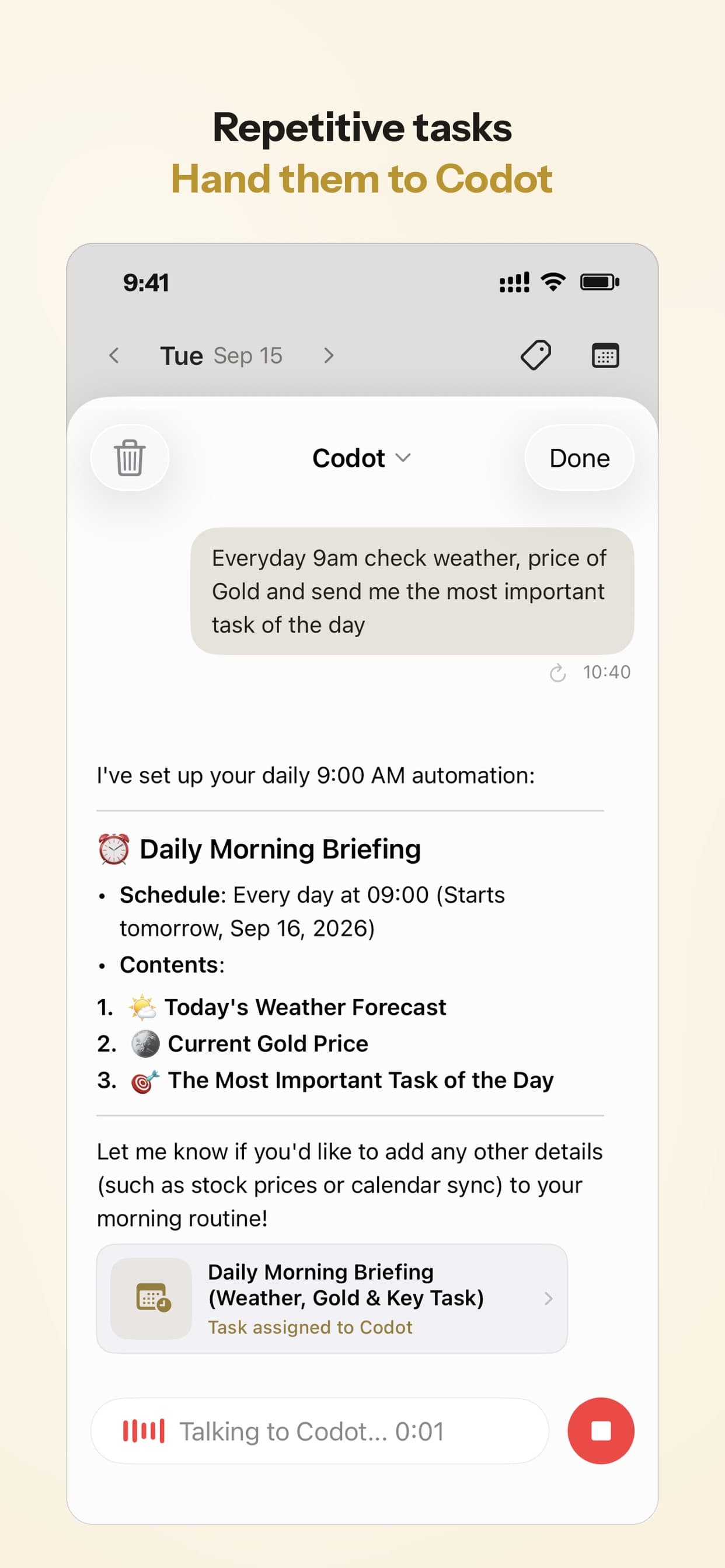
Here's what Sunday, November 8 looks like. You're on the sofa at 9pm, and you say: "Starting tomorrow, gym Monday, Wednesday and Friday at 7am, a 30-minute walk on the other days, study for the stats exam 8 to 9pm on weeknights, phone out of the bedroom by 10:30. Give me a briefing at 7 every morning and check in with me at 9 every night." Codot turns that into:
- Habits for the walk and the phone rule, which you tick off as the days go by
- Calendar blocks for the gym sessions and the study hour, synced with Google Calendar (and on iPhone, Apple Calendar)
- A 7:00 briefing with today's blocks and anything you didn't finish yesterday
- A 9:00 check-in, a scheduled automation that asks how the day went
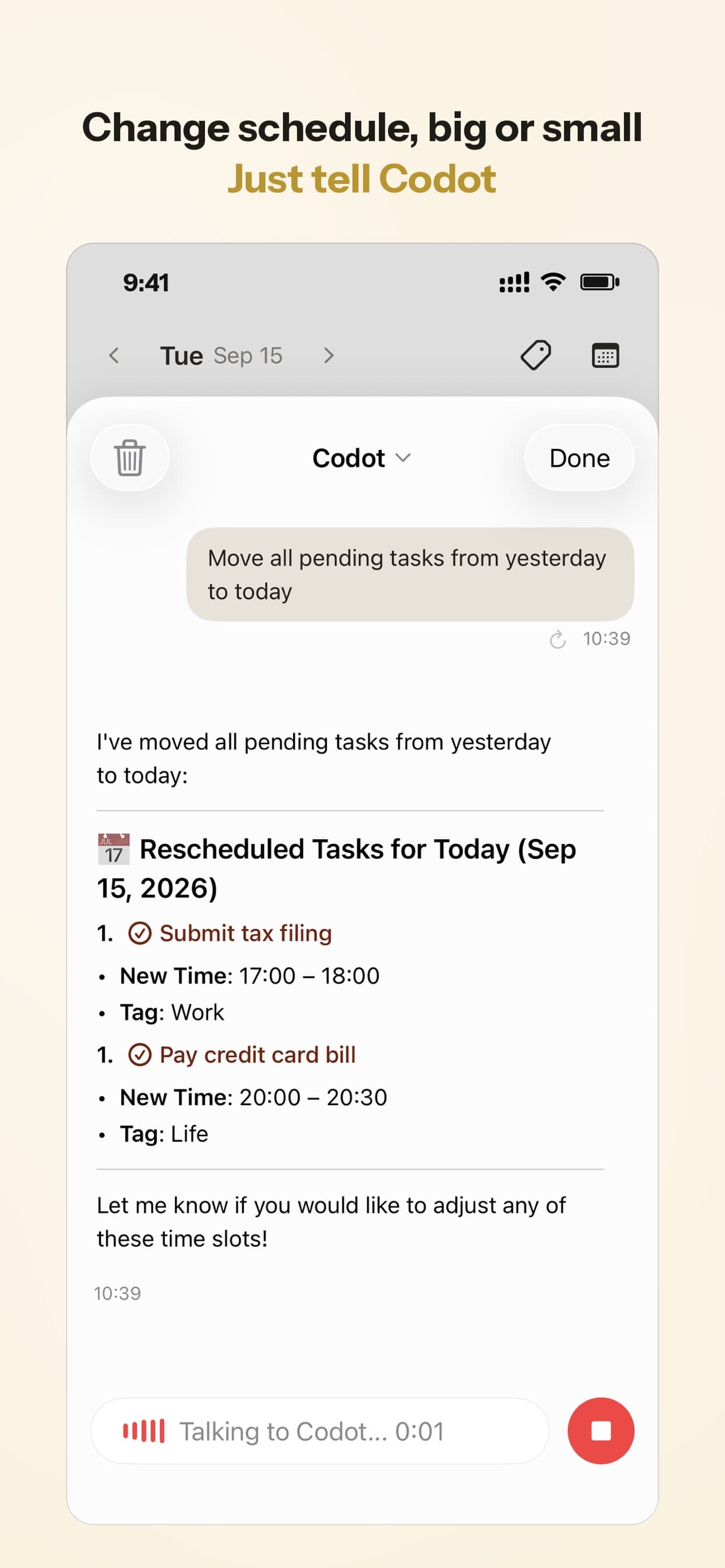
Then week 3 arrives. On Tuesday, November 24 you say: "This week fell apart, I'm travelling for Thanksgiving. Switch everything to minimum versions until Sunday and move the study block to mornings." Codot moves the blocks, and Wednesday's briefing shows the lighter plan. When you're back, one sentence puts the normal week back.
If your fourth rule is about food, you can log meals by voice or photo in the same app.
What Codot doesn't do: it has no friends list, group challenges or shared streaks, and there's no human coach behind it. It won't block apps on your phone, and it can't make you go to the gym.
Price (as of November 3, 2026): the free plan covers tasks, the calendar, notes, habits, calorie logging and expenses. The 7am briefing, the 9pm check-in and the repeating gym and study reminders are Codot Max features ($12.99/month or $99.99/year, with 20x the free plan's usage). Every new account gets 7 days of Max free, enough to test the first week of the plan; after that it drops back to the free plan without charging you.
How to choose your setup
- Paper or a plain habit tracker works if you already review your week without being reminded. We compared the free options in the best Winter Arc apps for iPhone and Android.
- Codot fits if you want to say the plan once and have something remind you, ask you at night and re-plan when the week changes. For more on that approach, see our guide to using an AI accountability partner for your gym, study and side-project system. If you want a full day laid out hour by hour, our copyable daily routine template is a good base for the weekday column above.
FAQ
Is it too late to start a Winter Arc in November 2026?
No. There's no official start date, and an eight-week plan from November 9 still ends with the year.
What are the Winter Arc rules?
There are no official ones. We recommend three or four, each with a time or number you can check at night.
Winter Arc vs 75 Hard: which should I do?
For a first challenge alongside school or work, the Winter Arc. 75 Hard's fixed tasks and restart rule suit people who want an all-or-nothing test.
How is Codot different from a Winter Arc app or habit tracker?
A habit tracker records check marks you enter. Codot takes one spoken sentence and sets up the habits, calendar blocks, a morning briefing and an evening check-in, and when your week changes you tell it and it moves things. It has no social or group features.
What should students put in a Winter Arc routine?
A fixed weekday study block, a movement rule and a sleep rule. In exam weeks, grow the study block and keep movement at its minimum.
If you'd like a life buddy to hold your Winter Arc plan from November 9 to January 3, say it once in Codot. Get Codot on the App Store or on Google Play.
Productivity & Tools Desk
This article was created with AI assistance and reviewed by our editorial team.Learn about our content process.