PTE Study Plan for 30 Days (2026): A Day-by-Day Schedule Around Uni and Job Applications, Plus an IELTS 1-Month Version
A dated 30-day PTE Academic study plan for students with classes and a job hunt: which skills on which days, weekly mock tests, review days, and an IELTS 1-month version.
A 30-day PTE Academic study plan works best in four blocks: a baseline mock on day 1, one test part per day in week 1, weakest question types first in weeks 2 and 3, a timed mock every Sunday with a review day after it, and light days before the test. PTE Academic is about 2 hours and scored 10 to 90. Codot turns the plan into daily tasks by voice for free.
Disclosure: Codot is our product. The student below is fictional, written to show how a 30-day plan runs next to classes and a job hunt. PTE Academic and IELTS facts come from pearsonpte.com and ielts.org, checked November 5, 2026. Nothing here predicts a score.
TL;DR:
- Thirty days is enough to learn the PTE format and practise every question type under time pressure. How far your score moves depends on where you start.
- The plan below is dated: day 1 is Friday, November 6, 2026 and the test is Saturday, December 5. Sundays are mocks, Mondays review them, Fridays stay light for coursework.
- Say the plan once and the days come to you. Codot turns one sentence into a practice task for each day (free). A 7:30 morning list and a 9pm check-in are Codot Max routines.
- Codot doesn't teach or score PTE. Use Pearson's official tools or a prep platform for questions; Codot keeps the schedule, the mock-score log and your notes.
- Taking IELTS instead? The same four-week shape works; the IELTS version is near the end.
At a glance
- PTE Academic takes about 2 hours, on a computer at an authorised test centre, and "cannot be taken at home" (Pearson).
- Three parts: Speaking & Writing 76–84 minutes, Reading 23–30, Listening 31–39, as of November 2026 (test format).
- Scoring: overall 10 to 90; most test takers get results within two business days (PTE scoring).
- IELTS Academic takes 2 hours 45 minutes; bands run 0 to 9 (IELTS Academic, IELTS scoring).
- Codot: voice input, one-off tasks, calendar, notes and habit tracking are free; timed and repeating reminders, the daily briefing and routines are Codot Max, $12.99 a month or $99.99 a year, with a 7-day free trial (codot.ai).
Who is this 30-day plan for?
Someone who already studies in English, needs a PTE score soon and can't study full time. Most 30-day plans online come from prep companies and assume whole free afternoons.
Meet Linh, a fictional master's student in Sydney. She booked PTE Academic for Saturday, December 5, because an application needs a score this year. She also has a 2,500-word essay due Friday, November 20, a group presentation on Wednesday, November 25, and a stack of café and retail job applications. On weekdays she has about 90 minutes for PTE; on weekends, closer to three hours.
Her real problem is the switching. Every evening she has to decide what to practise tomorrow, and on busy days that decision is what gets skipped.
What does a 30-day PTE study plan look like, day by day?
Baseline mock first, one part per day in week 1, weakest question types in weeks 2 and 3 with a timed mock every Sunday, and light days at the end. Linh's version:
| Days | Dates | Focus | Time |
|---|---|---|---|
| 1 | Fri Nov 6 | Baseline: one full timed mock (an official Scored Practice Test if budget allows) | 2.5 h |
| 2 | Sat Nov 7 | Review: where did time run out? | 2 h |
| 3 | Sun Nov 8 | Speaking: Read Aloud, Repeat Sentence, Describe Image | 2.5 h |
| 4 | Mon Nov 9 | Listening: Write from Dictation, Fill in the Blanks, Summarize Spoken Text | 90 min |
| 5 | Tue Nov 10 | Reading: both Fill in the Blanks types, Reorder Paragraph | 90 min |
| 6 | Wed Nov 11 | Writing: Summarize Written Text, Write Essay | 90 min |
| 7 | Thu Nov 12 | Speaking: Retell Lecture, Summarize Group Discussion, Respond to a Situation, Answer Short Question | 90 min |
| 8–9 | Fri Nov 13 – Sat Nov 14 | Friday 30 min dictation; Saturday weakest part, untimed then timed | 30 min / 2.5 h |
| 10 | Sun Nov 15 | Mock 2 | 2.5 h |
| 11–14 | Mon Nov 16 – Thu Nov 19 | Monday review, then weakest part twice, others once | 90 min |
| 15–16 | Fri Nov 20 – Sat Nov 21 | Friday light (essay due); Saturday full timed Speaking & Writing | 30 min / 2.5 h |
| 17 | Sun Nov 22 | Mock 3 | 2.5 h |
| 18–23 | Mon Nov 23 – Sat Nov 28 | Review, then timed section sets; short Wednesday and Friday | 30–90 min |
| 24 | Sun Nov 29 | Mock 4 (second official Scored Practice Test, if using one) | 2.5 h |
| 25–28 | Mon Nov 30 – Thu Dec 3 | Review, drills on the two slowest question types, last timed Reading and Listening | 60–90 min |
| 29 | Fri Dec 4 | Short speaking warm-up; check ID, test centre address, travel time | 20 min |
| 30 | Sat Dec 5 | Test day |
The question-type names come from Pearson's Speaking & Writing, Reading and Listening pages: nine scored types, five and eight respectively, as of November 2026. Speaking & Writing gets the most days because it is the longest part. Fridays stay short because when a plan collides with a coursework deadline, the plan loses.
What if you only have 15 days?
Compress the same shape: baseline mock on day 1, one part per day on days 2 to 5, mocks on days 8 and 13 with a review the day after each, and a light day 14. You lose most of the repetition on weak types, so set expectations accordingly.
How do you turn the plan into daily tasks without retyping it?
Say the whole plan once. On Thursday, November 5, at 9:40pm, Linh says to Codot:
"I'm sitting PTE Academic on Saturday, December 5. Make a practice task for every day from tomorrow to December 4: baseline mock Friday, full mock tests Sundays at 10am, review the mock on Mondays, Fridays 30 minutes only, other days rotate speaking, listening, reading and writing."
Codot creates a dated task for each of the 29 days with that day's focus, and writes them into Google Calendar or Apple Calendar beside her classes. One-off dated tasks are free. If she also wants her phone to alert her at 8:00 every morning, a timed or repeating reminder is Codot Max.
Her timetable goes in the same calendar. She photographs her class timetable and assessment list, and Codot reads the photo to add a class schedule to calendar entries automatically.
Job applications are one-offs too: "Apply to the two café jobs I saved by Wednesday, and the trial shift is Saturday the 14th at 7am." With the trial shift next to Saturday's practice, she moves practice to the afternoon.
What should a student see at 7:30 each morning?
Today's practice block and anything due in the next three days. Linh sets one routine:
"Every day at 7:30am, tell me today's PTE practice and any coursework or job application due in the next three days."
Routines are Codot Max. On Tuesday, November 17, the list reads: Reading, Reorder Paragraph and dropdown blanks, 90 minutes; essay due Friday; café application follow-up Wednesday. It's an essay week, so she does PTE at 8:00 and keeps the afternoon for the essay.
Codot also makes a daily briefing on iPhone at 7:00 with reminders, news and a summary (Codot Max, iPhone only).
What happens to the practice you didn't finish?
You decide where it goes, out loud, before bed. Codot doesn't move unfinished tasks on its own, and for exam prep that helps: sliding everything forward automatically is how a 30-day plan becomes a 30-day backlog. Linh's evening routine:
"Every night at 9, ask me which PTE tasks I finished today."
At 9:00 on Wednesday, November 11, Codot asks. She answers: "Did Summarize Written Text, skipped the essay. Move essay practice to Saturday morning and mark the rest done." Codot marks Wednesday's task done and puts essay practice on Saturday, November 14. If she ignores the question, Codot doesn't ask twice, so she answers it while brushing her teeth.
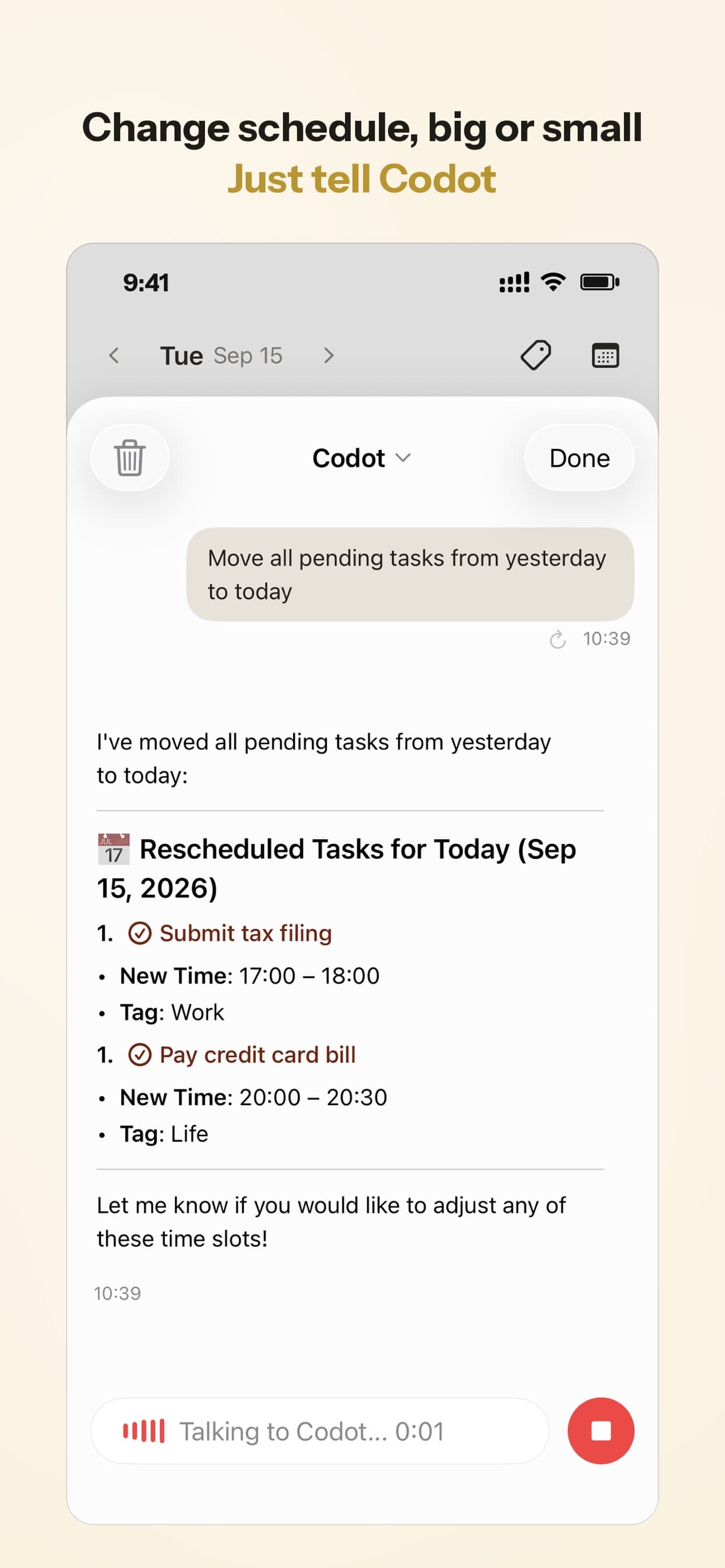
For the streak, habit tracking is free: "Track a daily habit called PTE practice." On presentation Wednesday, a 30-minute dictation set still counts.
Your ideas shouldn't wait for a keyboard. Just say it — Codot handles the rest.
Try Codot — It's Free →How do you track mock test scores week to week?
Keep every mock in one note and compare the same day. After mock 3 on Sunday, November 22, Linh says:
"Add to my PTE mock scores note: November 22, overall 61, speaking 58, writing 63, reading 60, listening 64. What changed since last Sunday?"
Codot adds the line to the note, which already holds November 6 and November 15, and reads back what moved. These numbers are invented for the example. Real mock scores bounce for reasons unrelated to skill, like a bad microphone or a late night, which is why Monday's review matters more than the number: she listens back to her recordings and picks the two question types for the week.
Use the same scoring source each time. Pearson's Scored Practice Test gives an overall score from 10 to 90 plus skill scores, and Pearson says it uses "the same AI engine as the real test" (Pearson).
How do you remember what went wrong in speaking practice?
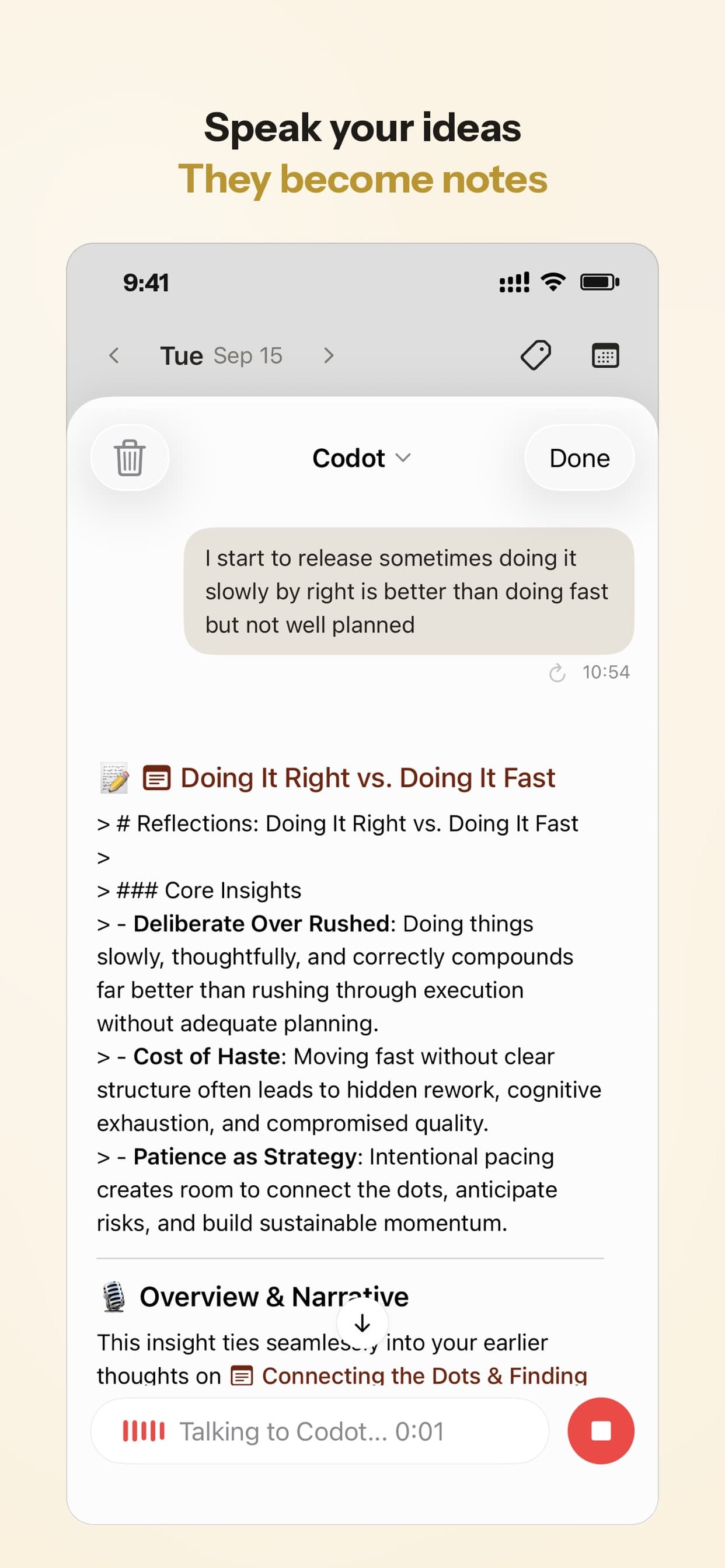
Say it right after the attempt. Speaking mistakes are about timing and hesitation, which are hard to reconstruct later. Linh records a voice note after each speaking set:
"Note for PTE speaking: Describe Image, froze on the bar chart again, spent ten seconds looking for the title. Next time start with the biggest number."
Codot saves it as a dated note with the question type and the fix. Notes are free. On review days she asks "What did I say about Describe Image this month?" and sees all her notes together, which shows whether the fix is working.
What about an IELTS study plan for 1 month?
Keep the four-week shape and change what goes into each day. IELTS Academic has four separately timed sections: Listening about 30 minutes, Reading 60, Writing 60 and Speaking 11–14 (ielts.org). Listening and Reading have 40 questions each, and the overall band is the average of the four section bands rounded to the nearest half band (IELTS scoring).
A typical IELTS week: two timed Writing days (Task 1 and Task 2), one full 60-minute Reading day, one Listening day, and short speaking practice most days, since Speaking is a conversation with an examiner and improves with frequency. Keep the Sunday mock and Monday review. The free IELTS Trial Test is timed and marked by an official IELTS examiner at participating locations, with unofficial results after 13 days (IELTS Trial Test), so sit it in week 1 if you want the results in time to use them.
Where do you get the actual practice questions?
Official materials first, then a prep platform if you want volume. As of November 2026:
- Pearson Scored Practice Test: a full 2-hour test with real past questions, scored 10 to 90; Pearson notes it is "not official certification" (pearsonpte.com). Good for day 1 and day 24.
- Official PTE AI Practice: official questions with instant AI scoring and feedback; a free tier, then US$29.99 for 7 days, $59.99 for a month or $89.99 for 3 months (pearsonpte.com).
- IELTS official preparation: sample questions, books, webinars and apps (ielts.org), plus the free Trial Test.
Is Codot a PTE or IELTS study app?
Codot is a voice AI personal assistant. It keeps your study plan, deadlines, scores and notes; the practice happens somewhere else. For Linh, the hard part was deciding each day what to practise while an essay and a job hunt competed for the same 90 minutes. Codot has been running for almost two years, and more people use it every month.
How we'd choose:
- New to the format? Start with Pearson's or IELTS's official materials and one scored mock, before any planner.
- Plenty of questions but skipping days? Codot is the missing piece: the daily tasks are free, and the 7:30 and 9pm routines come with Codot Max.
- Want feedback on every answer? That's a prep platform's job, used alongside the plan.
For keeping the habit after the test, see an AI accountability partner for study, gym and side projects and how students can pick a reminder app by how they forget.
What Codot doesn't do for exam prep
Codot has no PTE or IELTS questions, question bank, test simulation or scoring, and it can't predict your result or grade your speaking. It doesn't read events already in your calendar from other apps. It won't move unfinished practice unless you say so, and an unanswered check-in isn't sent again.
New accounts get 7 days of Codot Max free; afterwards you return to the free plan without being charged. Free: dated tasks, calendar entries, notes, voice input and habit tracking. Codot Max ($12.99 a month or $99.99 a year, 20x the free plan's usage): timed and repeating reminders, the daily briefing (iPhone only) and routines like the 7:30 list and 9pm check-in.
FAQ
Is 30 days enough to prepare for PTE Academic?
Thirty days is enough to learn all 22 scored PTE question types and practise them under time limits on a 2-hour test. How much your score changes depends on your starting level, so take a baseline mock on day 1.
How many hours a day should I study for PTE in a month?
With classes or a job, about 90 minutes on weekdays and two to three hours on weekend days is a pace you can hold for a month. A short session you do every day beats a long one you keep skipping.
How many mock tests should I take in 30 days?
This plan uses four: day 1 and each Sunday, with a review day after each. Pearson's Scored Practice Test is a full 2-hour test scored 10 to 90, a good choice for the first and last.
What is the best IELTS study planner app?
For questions, use IELTS's official materials or a prep platform. For the schedule, Codot turns a spoken 1-month IELTS plan into dated daily tasks for free, with morning and evening routines on Codot Max ($12.99 a month).
Can Codot score my PTE or IELTS practice?
No. Codot keeps your plan, reminders, mock-score note and speaking reflections. For scoring, use Pearson's Scored Practice Test, Official PTE AI Practice or an examiner-marked IELTS option.
Get tomorrow's practice block decided before tonight ends: download Codot on the App Store.
Productivity & Tools Desk
This article was created with AI assistance and reviewed by our editorial team.Learn about our content process.