How to Run a Small Engine Repair Shop in the Spring Rush (2026): Log Every Mower by Voice and Answer 'Is It Ready?' in Seconds
How a one-person small engine repair shop can log mowers, trimmers and chainsaws by voice at drop-off, answer status calls, chase back-ordered parts and clear the rack in April.
A one-person small engine repair shop gets through the spring rush by logging each machine at drop-off in one spoken sentence: tag number, customer, model, problem, quote and promised date. Codot, a voice AI assistant for iPhone, saves it as a job and a customer note for free and answers status calls from those notes. An afternoon parts list and an end-of-day pickup check run on Codot Max at $12.99 a month.
Disclosure: Codot is our product. The shop owner and customers below are fictional, written to show one week of a real spring rush. Codot prices are from codot.ai; Orderry and RO App details are from their own pricing and product pages, checked November 4, 2026.
TL;DR:
- In April a one-person small engine shop has two jobs: fixing machines, and answering "is my mower ready?" The second one is what eats the day, because the answer lives on a paper tag somewhere in a row of 40 mowers.
- Log every machine at drop-off in one sentence: tag number, customer, model, problem, quote, promised date. Codot saves it as a job and a note on the customer's contact, free.
- When the phone rings, ask Codot instead of walking the rack: "What's the status of the Hendersons' Toro?" gets the tag, the quote, the promised day and the last thing you said about it.
- Three routines keep promises honest: a 3pm list of tomorrow's promised machines and missing parts, a reminder when a back-ordered carburetor should be in, and a 6pm check of what's done and picked up. These are Codot Max.
- Shop software like Orderry and RO App texts customers when a job changes stage and tracks parts inventory. Codot is the assistant you talk to with a pull cord in your hand.
At a glance
- Orderry markets itself to lawn mower and small engine repair shops, with repair tickets that move through stages like "waiting for parts" and "ready for pickup", SMS or email updates, and parts inventory. Plans are listed from $69 a month (Startup, 3 employees), with a $39-a-month Hobby plan for 2 employees (Orderry pricing, Orderry for small engine shops).
- RO App lists plans from €29 a month (All-in-One, excluding VAT), and its comparison table includes automated notifications and reminders on every plan (RO App pricing).
- Codot: voice input, tasks, notes and contacts with notes are free. Timed and repeating reminders, the daily briefing and scheduled automations are Codot Max at $12.99 a month or $99.99 a year (20x the free plan's usage), with a 7-day free Max trial (codot.ai).
Why does the spring rush swamp a small engine repair shop?
It swamps the shop because every customer discovers a dead mower in the same two weeks. The first warm weekend in April, people pull the cord, nothing happens, and the machines arrive all at once. A Wisconsin shop owner described his spring as running on "wait lists and call lists" (WSAW), and an Iowa hardware store that fixes mowers told its local paper that the busy stretch normally runs until the hot, dry part of summer (Solon Economist).
Dale Brenner runs Brenner Small Engine out of a two-door garage in Cedar Falls, Iowa. Mowers, string trimmers, chainsaws, a few small generators. No counter staff. By mid-April he has 38 machines inside and a dozen more on the gravel out front, each with a paper tag wired to the handle.
A carb clean takes 40 minutes; the phone takes longer. A customer calls, Dale wipes his hands, walks the rows looking for tag 214, flips it over, and tries to remember whether he already ordered the part. Six of those calls a day is an hour gone, and the answers are still guesses.
Shop software fixes the front counter for shops that have one. Dale's front counter is the workbench, and the only thing free when a customer hands him a mower is his voice.
Monday 8:15, at drop-off: how do you log a mower without stopping to write?
Say the whole ticket in one sentence while the customer is still standing there. On Monday, April 13, Linda Henderson rolls in a Toro that won't start after winter. Dale wires on tag 214 and says to Codot:
"Tag 214: Linda Henderson, Toro Recycler 22-inch, won't start after winter, probably the carburetor, quoted 95 for clean and tune, promised Friday."
Codot saves a job dated Friday, April 17, with the tag, the model, the problem and the quote in it, and adds a note to Linda Henderson's contact with the same details. Both are on the free plan. Codot also writes the job into Google Calendar or Apple Calendar, so Friday's promises show up in the calendar Dale already checks on his phone.
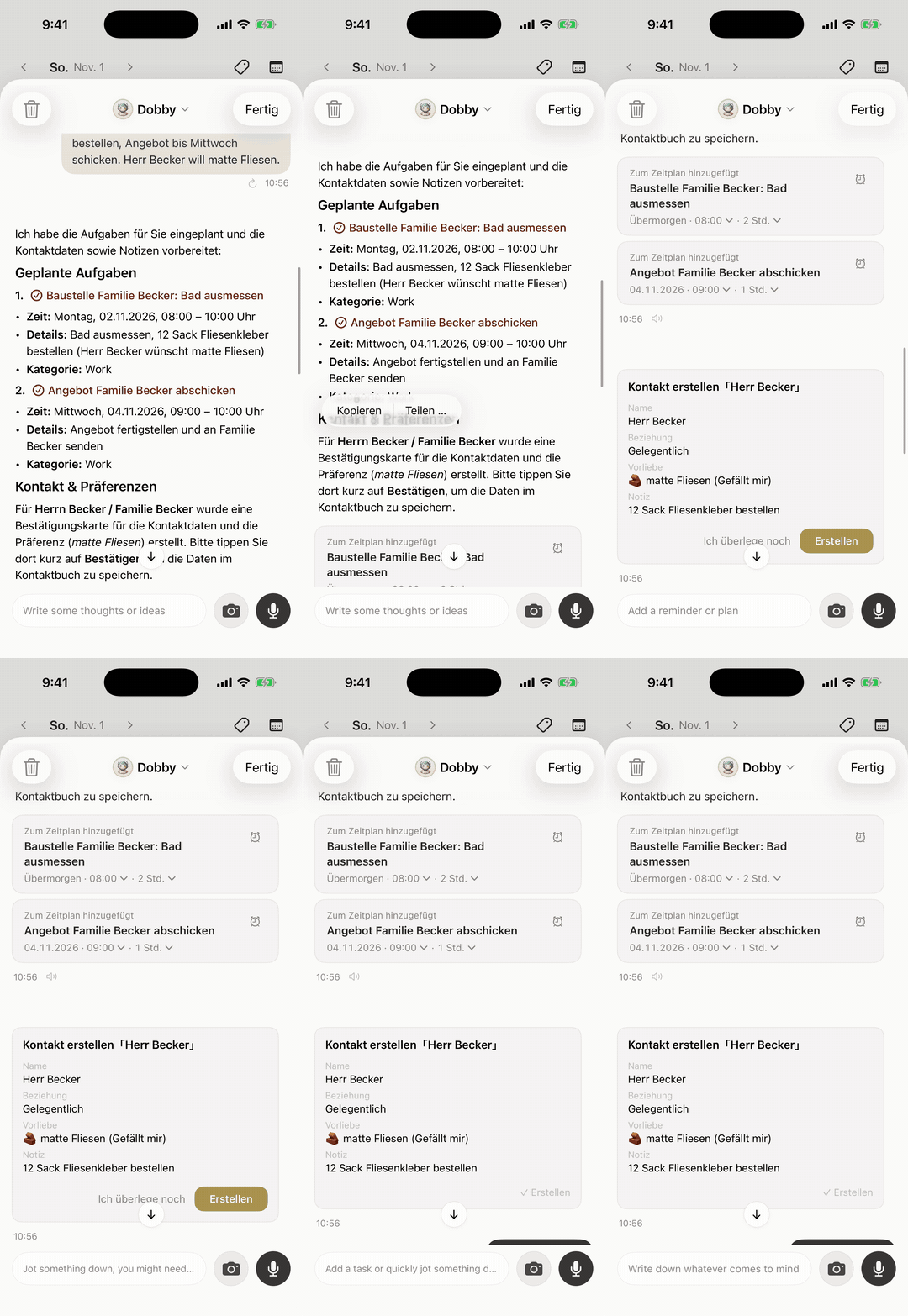
Ten minutes later it's a Stihl trimmer: "Tag 215: Gary Olsen, Stihl FS 56 trimmer, bogs at full throttle, quoted 60, promised Thursday." Same order every time. The tag number matters most, because it links the paper on the handle to everything Codot knows about that machine.
Wednesday 10:40: how do you answer "is my mower ready?" without walking the rack?
Ask Codot while the customer is on the line. On Wednesday Linda calls. Dale doesn't put the phone down to go hunting; he asks:
"What's the status of the Hendersons' Toro?"
Codot answers from what he's told it: tag 214, Toro Recycler, carb clean and tune quoted at $95, promised Friday. On Tuesday afternoon Dale had pulled the carburetor and said, "Hendersons' Toro: carb is varnished past cleaning, needs a new one, about 48 more for the part, ordered, supplier says next Tuesday." So Codot reads that back too.
The call takes 40 seconds, and Dale gives Linda the real story: Friday is off, and the extra $48 needs her OK. She says go ahead. He tells Codot "Linda approved the new carb, total 143, now promised Wednesday the 22nd," and the job moves.
This only works if every update gets said out loud when it happens, which costs five seconds at the bench.
3:00 every afternoon: how do you see which promised machines still need parts?
Set one afternoon routine that lists everything promised for tomorrow and flags what's waiting on parts. Dale set it once:
"Every weekday at 3pm, list the machines promised for tomorrow with tag numbers, and tell me which ones are still waiting on parts."
Scheduled automations are a Codot Max feature. On Wednesday at 3:00 the list says: tag 215, Gary's Stihl trimmer, no parts needed; tag 198, a Honda generator, still waiting on a fuel valve; tag 207, a Husqvarna chainsaw, chain and bar in stock. That leaves Dale two hours to finish the trimmer, and to call the generator owner tonight instead of letting him show up tomorrow to a machine in pieces.
Codot doesn't look up or order parts; it lists what Dale told it.
Back-ordered parts and approvals: how do you remember to call when the carburetor shows up?
Set a timed reminder the moment you order the part or leave the voicemail. When Dale ordered the Henderson carb on Tuesday, he said:
"Remind me next Tuesday at 10 to check if the Henderson carburetor came in, and if it did, call Linda."
On Tuesday, April 21, at 10:00, the reminder lands on his lock screen. The UPS box is on the bench, so he calls Linda and sets the Toro on the stand.

Approvals work the same way. Gary's trimmer turns out to need a new fuel line and primer bulb too. Dale gets voicemail and says: "Gary's Stihl, tag 215: fuel line and primer bulb, 25 more, left voicemail, remind me at 2 to call again." Timed reminders are Codot Max.
One thing to know: Codot reminds you once. If you swipe a reminder away without acting, it won't come back on its own. When Dale's hands are full at 2:00, he says "remind me at 4 instead" before he swipes, so the callback doesn't disappear.
Your ideas shouldn't wait for a keyboard. Just say it — Codot handles the rest.
Try Codot — It's Free →6:00 every evening: how do you know which machines are done and picked up?
Answer one question at closing time, out loud. In April the rack fills faster than it empties, and a finished mower nobody's picked up takes the same space as a broken one. Dale's routine:
"Every weekday at 6pm, ask me which machines got finished today and which got picked up."
At 6:00 Codot asks. Dale says: "Tag 215 Stihl done and picked up. Tag 207 chainsaw done, owner coming Saturday. Tag 190 Craftsman done, called twice, no answer." Codot marks the jobs done and adds "coming Saturday" and "called twice, no answer" to those customers' contacts.
On Friday he asks, "Which finished machines haven't been picked up yet?" and gets a short list of who to call before the weekend, so Monday's drop-offs have somewhere to go. He can also ask "How much did we finish this week?" and Codot adds up the quotes in the jobs marked done; invoices and taxes stay in his invoicing app.
What about the fall: how do you get last spring's customers back for winterizing?
Set a reminder in spring for the fall call list, while the names are fresh. Every customer from April is already a contact with their machine noted, so in late April Dale said:
"Remind me on September 15 to list everyone who brought in a mower or generator this spring, so I can call them about winterizing."
On September 15 the reminder fires. He asks for the list, and Codot pulls it from his contacts with each machine attached. Twenty calls on a slow afternoon fill October with tune-ups and generator checks. A reminder that far out is Codot Max; the contacts and notes it reads from are free.
Is Codot small engine repair shop software?
Codot is a voice AI personal assistant, not shop management software, and for a one-person shop or a mobile mechanic in a van, that's often the missing piece. You say the ticket; it saves the job and the customer. You ask what's promised tomorrow, what's stuck on parts, who to call back and what's sitting finished on the rack, and it answers from what you've told it. Codot has been running for almost two years, and more people use it every month.
How we'd choose, based on where the shop actually stalls:
- If tickets live on paper tags and the phone costs you an hour a day, start with Codot. It's the fastest way to log a machine at drop-off, and the free plan covers jobs and customer notes.
- If you want customers texted automatically when a job hits "ready for pickup," plus parts inventory and invoices in one system, look at Orderry (from $69 a month, or $39 for its 2-employee Hobby plan) or RO App (from €29 a month).
For more on running a one-person trade business, see our handyman weekly system, contractor scheduling apps compared and apps for tradies: office software vs. a voice assistant on site.
How to set it up before the first warm weekend
- Install Codot on your iPhone from the App Store and connect Google Calendar or Apple Calendar so promised dates show up where you already look.
- Log the next five drop-offs by voice in the same order: tag, customer, machine, problem, quote, promised day.
- Set the afternoon list: "Every weekday at 3pm, list the machines promised for tomorrow with tag numbers, and tell me which ones are still waiting on parts."
- Set the closing check: "Every weekday at 6pm, ask me which machines got finished today and which got picked up."
- Every time you order a part or leave a voicemail, set the callback reminder right then.
New accounts get 7 days of Codot Max free, enough to run a full spring week with the routines on. When the trial ends you go back to the free plan without being charged.
What Codot doesn't do for a small engine shop
Codot doesn't text your customers, write estimates or invoices, take payments, look up or order parts, or track parts inventory; Orderry and RO App do those. It doesn't read appointments already in your calendar from other tools, and it doesn't give customers a status page to check. It can send an email for you, but not a text message. Reminders fire once and aren't re-sent if you ignore them.
On the free plan you keep jobs, calendar entries, customer contacts with notes and voice input. Timed and repeating reminders, the daily briefing and scheduled automations like the 3pm parts list and the 6pm pickup check need Codot Max: $12.99 a month or $99.99 a year, with 20x the free plan's usage. The daily briefing is iPhone only.
FAQ
How do you run a small engine repair shop during the spring rush?
Log every machine at drop-off with a tag number, the customer, the problem, a quote and a promised date, then check each afternoon what's promised for tomorrow and what's missing parts. Codot saves the drop-off by voice on the free plan and runs the afternoon list on Codot Max ($12.99 a month).
What software do small engine repair shops use?
Shops with counter staff often use repair shop software such as Orderry (from $69 a month as of November 2026) or RO App (from €29 a month), which track tickets, parts and customer texts. A one-person shop can start with Codot to log jobs and customer notes by voice for free.
How do I stop customers calling to ask if their mower is ready?
Keep every update on the customer's record so each call takes seconds, and call people first when a part is late. In Codot you ask "what's the status of the Hendersons' Toro?" and it answers from your notes; a reminder on Codot Max tells you when to call about a back-ordered part.
Does Codot text customers when their machine is ready?
No. Codot reminds you, not your customers, and it can send email but not text messages. For automatic "ready for pickup" texts, use shop software like Orderry or RO App.
If you'd like the next "is my mower ready?" call to take 40 seconds instead of a walk down the rack, get Codot on the App Store.
Founders & Professionals Desk
This article was created with AI assistance and reviewed by our editorial team.Learn about our content process.