What Is the ADHD Tax? Real Examples, What the Research Shows, and How to Pay Less (2026)
The ADHD tax is the late fees, wasted food, forgotten subscriptions and lost hours ADHD costs you. Real examples, what a 2020 study found, and fixes that work.
The ADHD tax is an informal name for the extra money, time and stress that ADHD symptoms cost you: late fees, food that spoils, subscriptions you meant to cancel, rush shipping, missed appointments. It is not a real tax or a diagnosis, but the cost is measurable: a Swedish population study found adults with ADHD were over four times more likely to have unpaid debts sent to enforcement.
Disclosure: Codot, a voice assistant that comes up near the end of this article, is our product. We're not clinicians or tax advisers. Research claims link to their sources (checked October 29, 2026).
TL;DR:
- The ADHD tax is slang, not a tax. It covers three kinds of cost: money (fees, waste, duplicates), time (redoing, searching, rushing) and the emotional bill (shame, strained relationships).
- The money part shows up in data. In a study of Sweden's whole population, adults with ADHD started out with normal default rates, then fell behind in middle age and were over four times more likely to have unpaid claims sent to the national enforcement agency.
- Most of the tax is paid in the gap between "I should do that" and doing it. The fixes that work shrink that gap: automate what repeats, and capture what doesn't in under ten seconds.
- No app removes the ADHD tax. A bank's autopay, your phone's subscription list and one place for every "future me" task do most of the work. Codot can be that last piece.
What does "ADHD tax" mean?
People with ADHD coined the phrase for a familiar pattern: you know the bill is due, you mean to pay it, and two weeks later you pay it plus a $35 late fee. The tax is the gap between intention and action, priced out.
There is no clinical definition. Understood.org and ADDitude both describe it as a financial cost and an emotional one, and ADDitude adds the lost income from jobs and opportunities that slip. I find it more useful to split it three ways, because each part needs a different fix:
| Kind | What you pay | Typical cause |
|---|---|---|
| Money | Late fees, interest, spoiled food, unused subscriptions, duplicate purchases, rush shipping | Forgetting, then paying to make up for it |
| Time | Hunting for keys and documents, redoing work, rebooking, sitting on hold to dispute a fee | Things living in your head instead of somewhere you can see |
| Emotional | Guilt, "why can't I just do it", partners and coworkers losing patience | Repeating the same miss after promising yourself it wouldn't happen again |
What are common ADHD tax examples?
Most people recognize themselves in at least half of these:
- The grocery tax. Vegetables bought with good intentions rot in the crisper, then dinner becomes delivery. "ADHD grocery tax" and "ADHD tax food" show up in Google's autocomplete for a reason.
- Subscriptions. The free trial that turned into a year, the gym you stopped going to in March.
- Late fees and interest. Bills paid a week late, a credit card balance that ran past the grace period.
- Duplicates. Buying a second charger, a third pair of scissors, the same book twice, because finding the first one costs more effort than buying another.
- Appointment fees. No-show charges at the dentist, a rebooked flight, a parking ticket because the meter ran out during the meeting that ran long.
- Rush costs. Express shipping for a birthday you remembered the day before.
- Paperwork you didn't open. Letters from the tax office or a doctor's office that turn into penalties because they sat unopened.
Every item on that list started as a moment when you knew what to do. The miss came later, when the thought had nowhere to go.
Is the ADHD tax real? What the research shows
The dollar figures you see online ("$1,000 a year") are guesses from surveys and anecdotes, so I won't repeat them. The research that does exist points the same way.
The strongest study I found is Beauchaine, Ben-David and Bos (2020) in *Science Advances*. They linked mental health records for Sweden's entire population (11.55 million people) with credit data for a random sample of 189,267. After controlling for other psychiatric conditions, substance use, education and income:
- Adults with ADHD began adulthood with normal credit demand and default rates.
- In middle age their default rates rose sharply, and they were more than four times as likely to have unpaid claims (bank overdrafts, unpaid support payments, unpaid road taxes) sent to Sweden's enforcement agency. The authors note many of those claims were small, like parking fines.
- Financial distress was associated with a three- to fourfold higher risk of suicide among people with ADHD.
- ADHD medication prescriptions were not associated with better financial behavior.
That last finding matters for how you fix it. Medication can help with focus, but in this study it didn't change who paid the bills on time, which suggests the habits and systems around money need work of their own. It's one study and it shows association, not cause.
ADDitude also cites earlier work on the same theme: adults with ADHD show weaker financial decision-making (Bangma et al., 2019) and earn less over a lifetime (Barkley, Murphy and Fischer, 2008).
If the money worries feel heavy, please talk to someone. In the US you can call or text 988.
Your ideas shouldn't wait for a keyboard. Just say it — Codot handles the rest.
The hidden part: paying in app switches
The original version of this article was about one specific slice of the tax, and I still think it's underrated. Many people with ADHD try to fix the problem with more tools: a task app, a calendar, a notes app, a budgeting app, a habit tracker. Each one is reasonable on its own. Together they create a new job, which is remembering which app a thought belongs in.
Take one thought: "Call the dentist to move Thursday's appointment, and remember Sam's birthday is Saturday." In a five-app setup that's a calendar edit, a task, and maybe a note about what to get Sam. Every switch is a chance to see a notification and lose the thread.
The American Psychological Association's summary of task-switching research says the mental blocks from shifting between tasks can cost as much as 40% of someone's productive time. That figure comes from studies of people in general, not ADHD specifically, so take it as a ceiling, not a measurement of you. For an ADHD brain that already struggles to hold a thought in working memory (more on that in ADHD and forgetting things the second you think of them), the switch is often where the thought dies.
ADHD researcher Russell Barkley calls the moment you need to act the "point of performance": help has to be there, at that moment, or it doesn't count. A system you have to navigate fails that test.
How do you pay less ADHD tax?
You won't get it to zero, and trying to build a perfect system is its own tax. Here's the order I'd go in, cheapest first.
1. Run a 20-minute audit
Open the last three months of your bank and card statements. Mark every fee, every subscription you didn't use, every delivery order that replaced food you already had. Total it. Seeing the real number turns a vague guilty feeling into a short list you can work through.
2. Automate everything that repeats
Autopay for every fixed bill, set to the minimum if you're worried about overdrafts. Calendar reminders three days before each annual renewal. On iPhone, Settings > your name > Subscriptions shows every App Store subscription in one list; cancel there in a minute. This step needs no willpower after the first afternoon.
3. Shrink the capture step to under ten seconds
Things that don't repeat (call the dentist, return the parcel, or follow up with a customer) need one place to land the second you think of them. If that place takes four taps and a category, you'll skip it. Voice is the fastest input most of us have: you can say a sentence while walking or cooking.
4. Make tomorrow visible
A list you have to remember to open doesn't help much with ADHD. Put it where you'll see it without deciding to: a lock-screen widget, a morning message, a paper card by the door. External structure for ADHD goes deeper on why this works.
5. Ask for the fee back
Many banks and utilities waive a first late fee if you call and ask. It takes ten minutes and recovers money you already lost. Put "call bank about the fee" on the same capture list.
6. Give the week ten minutes
Once a week, look at what's coming and move what won't happen. If you want a ready-made structure, the ADHD daily routine template has one you can copy.
Where Codot fits
Codot covers steps 3, 4 and part of 6. You talk to it the way you'd leave yourself a voice memo, and it turns the sentence into the right things: tasks, calendar events (it syncs with Google Calendar), notes, or details about a person.
Try this in 30 seconds. Open Codot from the lock-screen widget or your Apple Watch and say: "Move the dentist to Monday at 3, remind me Friday to buy Sam's birthday present, and cancel the gym membership before the 15th." You get the calendar change and two dated reminders without opening a single menu.
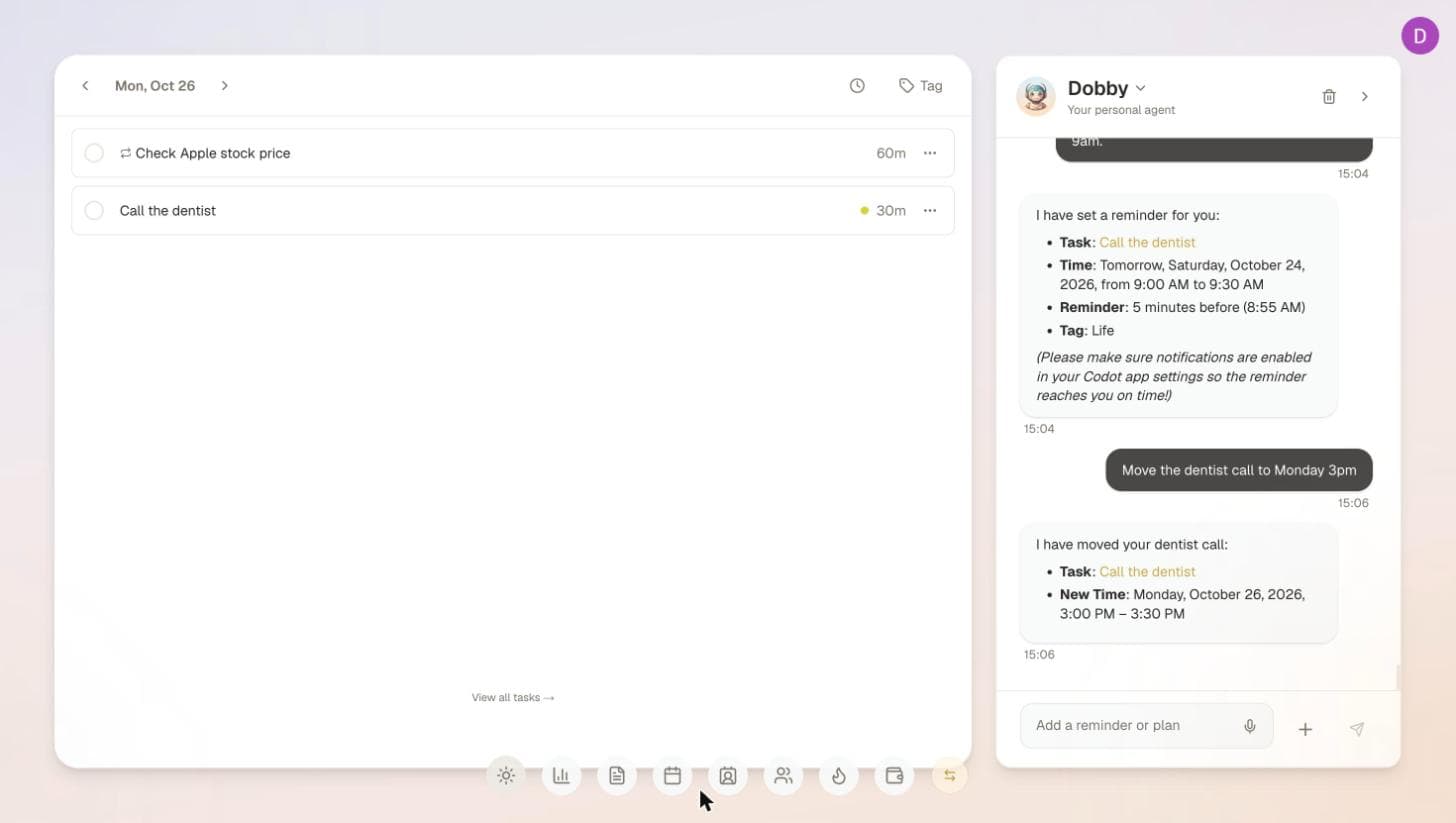
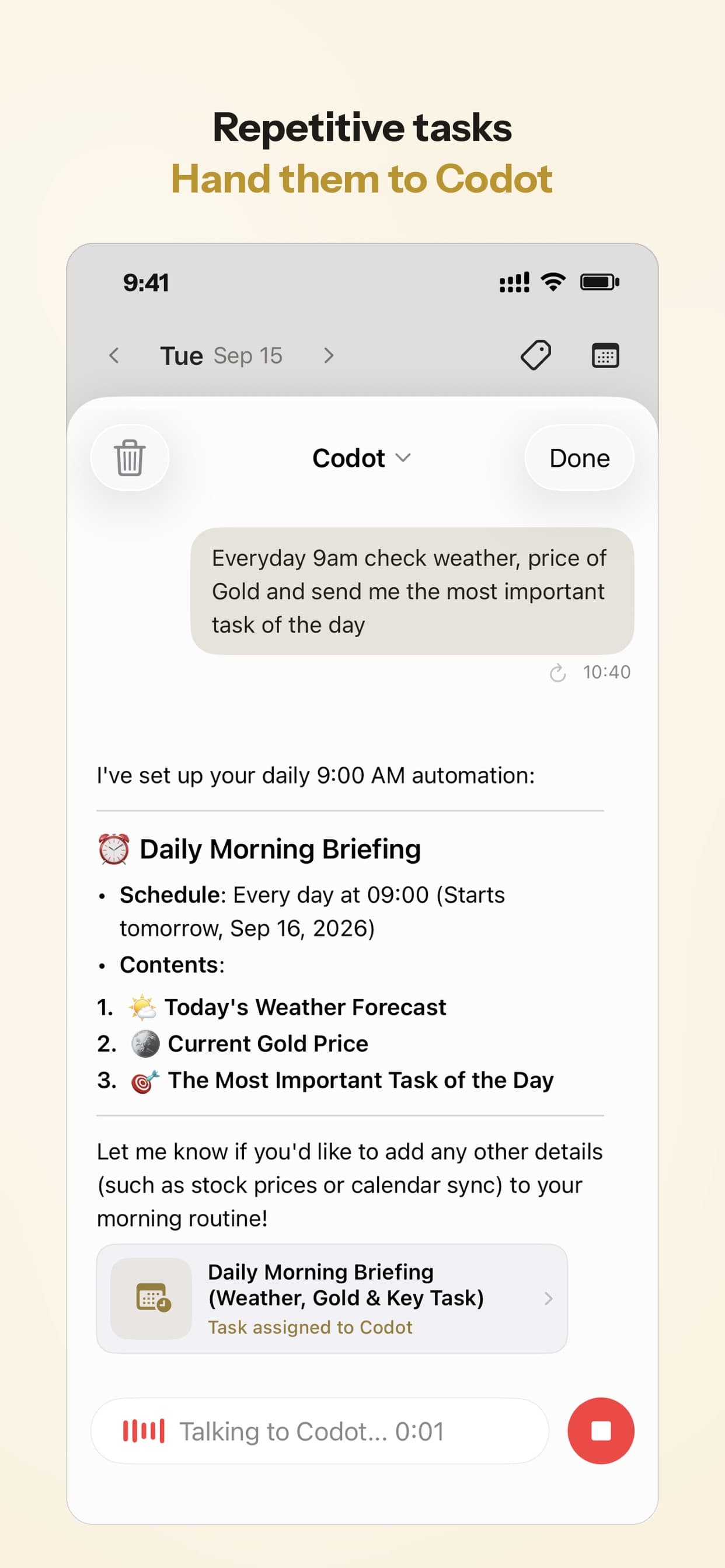
For step 4, a daily briefing sends you the day's reminders each morning, and scheduled automations can repeat a nudge ("every 1st of the month: check subscriptions").
App Store reviewers mostly mention the same thing: events land in their phone calendar without typing them in one by one, and a few say it replaced a paper planner.
What Codot can't do for your ADHD tax: it can't pay a bill, cancel a subscription on a website or call your bank for you. It holds the intention and puts it in front of you at the right time. You still press the button. Codot's free plan covers tasks, the calendar, notes, the personal CRM, habits, calorie logging and expenses. Reminders at a set time, repeating tasks, daily briefings, scheduled automations and email triage are part of Codot Max ($12.99 a month or $99.99 a year, with 20x the free plan's usage). Every new account gets 7 days of Max free, then drops back to the free plan without charging you.
Is there an ADHD tax app?
People search for one, so here's my honest answer: no single app removes the ADHD tax, and buying several to try is a classic way to pay more of it. What works is a small stack you barely touch:
- Your bank's autopay and alerts for bills (free, already exists).
- Your phone's subscription list for App Store and Google Play subscriptions, plus a calendar reminder before each annual renewal.
- One capture tool for everything else. That can be a paper card if paper works for you. I'd pick something you can talk to, because that's the fastest way to catch a thought before it's gone. If you want to compare options, I ranked AI assistants for ADHD by setup effort.
Frequently asked questions
Is the ADHD tax a real tax?
No. It's a community term for the extra costs of living with ADHD. No government collects it, and it isn't a diagnosis. The costs themselves are real and show up in bank statements.
Can you claim ADHD costs on your taxes?
Sometimes, depending on where you live. In the US, diagnosis, treatment and prescribed medication can count as medical expenses, which you can deduct only if you itemize and only the part above 7.5% of your adjusted gross income (IRS Publication 502). Canada, the UK and other countries have their own rules and credits. Ask a tax professional before you count on it.
Does ADHD medication reduce the ADHD tax?
It can help with attention, but the Swedish population study found no link between ADHD prescriptions and better financial outcomes. Treat medication and money systems as two separate jobs.
How is Codot different from a to-do app?
A to-do app waits for you to open it, type and file. Codot is an assistant: you say a messy sentence and it creates the tasks and events, reschedules when you ask, and sends a morning briefing so the list finds you. It won't pay bills or act on websites for you.
If you've added up your own ADHD tax and want somewhere for the "I'll do it later" thoughts to land, Codot is a free download, with a 7-day Max trial, on the App Store and Google Play.
ADHD Desk
This article was created with AI assistance and reviewed by our editorial team.Learn about our content process.